The Merchant's Daughter

Issue #7 · 1946: The Front Room School

1946

In 1946, the first full year of peace, six-year-old Mei Lin starts school in a neighbour's front room. Tan Cheng Huat's trade grows, but he does not manage to reopen a proper firm, is fined by a price-control inspector, and loses a consignment he had already paid for. Lim Swee Neo queues for rice, sews little, and receives news at last of a relative's household. Nobody in the family is seriously ill.

A work of fiction set in real history. The characters are invented; the historical events are real and sourced.

Previously, in 1945…

In 1945 the Japanese Occupation ends. Early in the year soldiers search the Tan house and frighten Lim Swee Neo, who is already weakened by hunger, and her sewing falls off. When Japan surrenders in August, the street comes together, and when the British return Tan Cheng Huat is among the first to trade again. Five-year-old Mei Lin has a quiet year, and all three of them are alive when it ends.

1946
The Front Room School
Tan Mei Lin, 6
the child of the house, starting school

Tan Cheng Huat, 38
her father, a merchant
Lim Swee Neo, 31
her mother
1946 · page 1
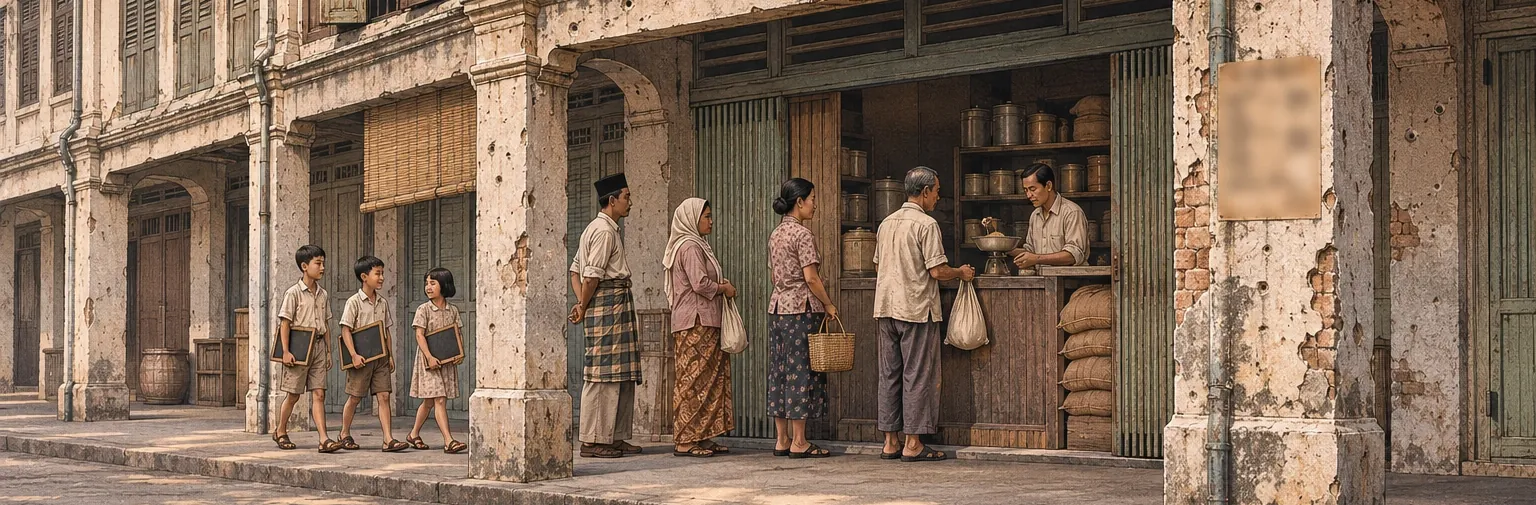
A shophouse street in the first year of peace: shell-pocked plaster on the house fronts, a printed government notice of controlled prices pasted on a pillar, a short queue at a ration shop, children with slates walking along the five-foot way.
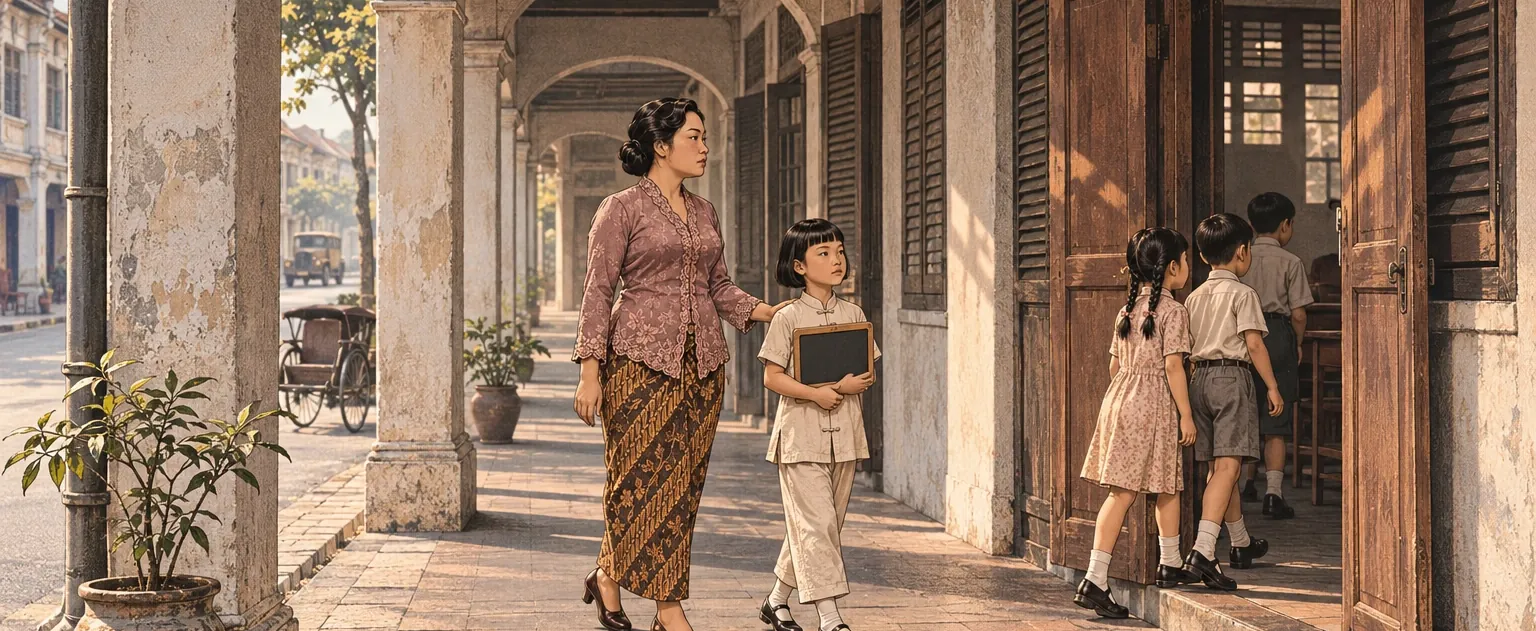
Swee Neo, thin and careful in her movements, walks Mei Lin, a six-year-old girl in a clean white cotton tunic let out at the hem, with a short bob and a straight fringe, holding a slate, toward an open shophouse door where other children are going in.
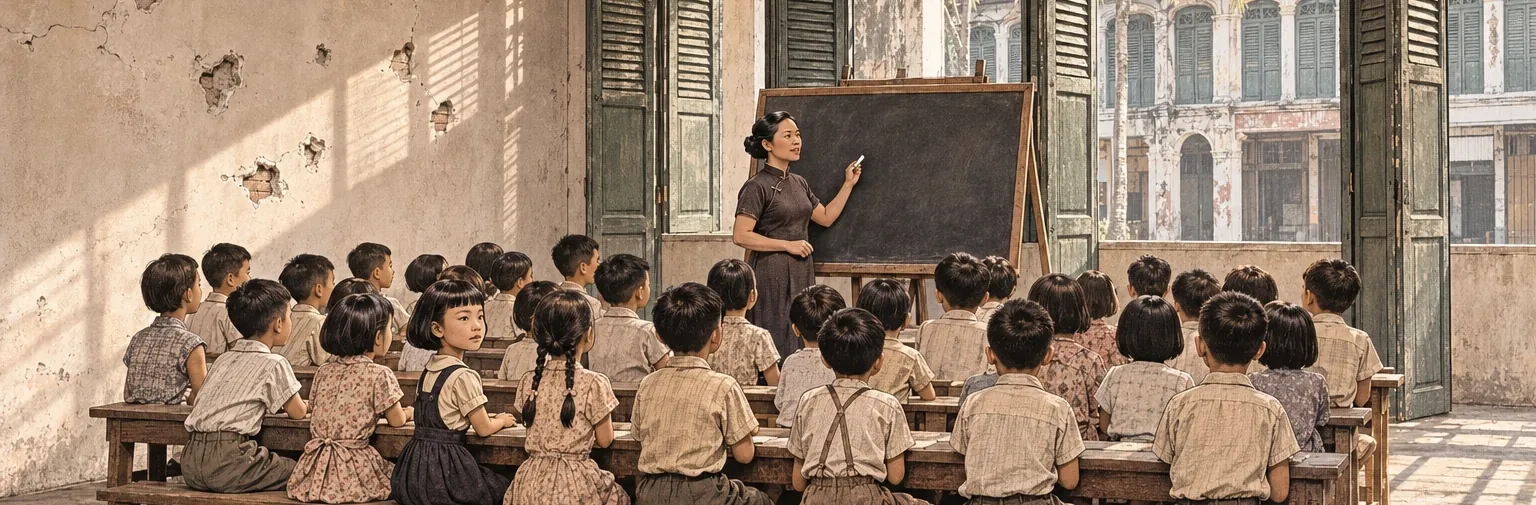
About thirty children sit packed on wooden benches facing a blackboard on an easel; a woman teacher of about forty in a plain cheongsam stands at the front with a piece of chalk; Mei Lin, a six-year-old girl with a short bob and a straight fringe, is the smallest in the second row.
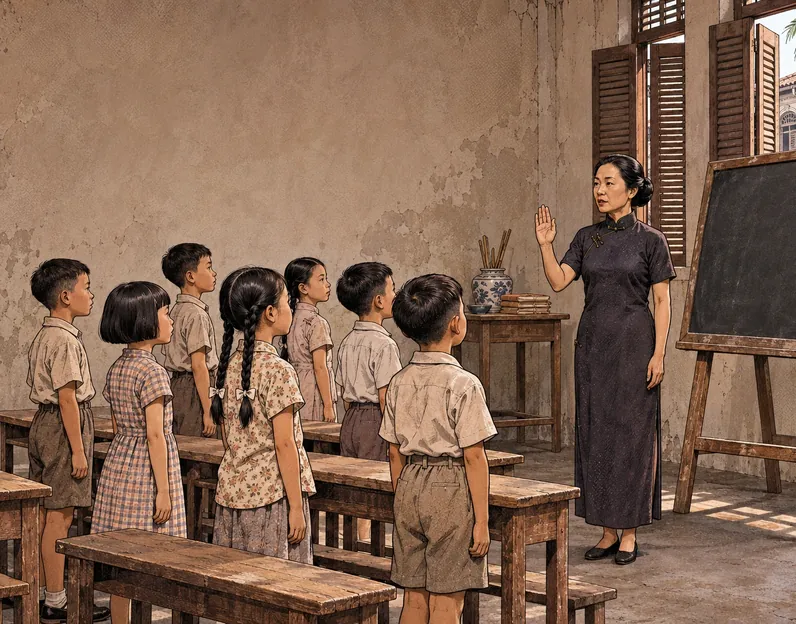
The teacher stands at the blackboard with one hand raised; the children in the front rows have risen to their feet beside their benches.
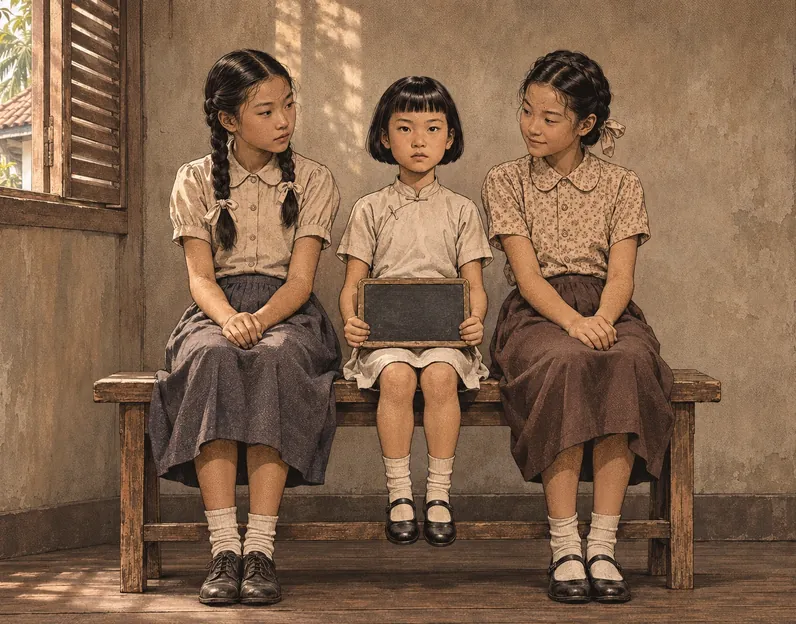
Mei Lin, a six-year-old girl in a white cotton tunic with a short bob and a straight fringe, sits bolt upright on a crowded bench between two bigger girls, her feet not reaching the floor, slate on her knees.
1946: THE FIRST FULL YEAR OF PEACE. SINGAPORE WASUNDER BRITISH MILITARY RULE UNTIL APRIL, THEN A CROWNCOLONY.FOOD WAS STILL SHORT AND RATIONED. THEREWERE PRICE CONTROLS, AND A BLACK MARKETAROUND THEM.MEI LIN, 6, COULD WRITE HER OWN NAME. ONTHE FIRST MORNING HER MOTHER WALKED HERTO THE DOOR, IN A CLEAN TUNIC LET OUT ATTHE HEM.LIM SWEE NEO, 31, STOOD IN THELANE UNTIL THE DOOR CLOSEDBEHIND HER.THE SCHOOL WAS NOT IN A SCHOOL. IT WAS THE FRONT ROOMOF A HOUSE THREE DOORS DOWN, WITH SHELL-MARKS STILL ONTHE PLASTER.THIRTY CHILDREN ONBENCHES, AND ABLACKBOARD BORROWED FROMA CHURCH.THE TEACHER HAD TAUGHT BEFORE THE WAR. SHE HADBEEN, THE STREET SAID, A CLERK IN THEOCCUPATION. NOBODY ASKED HER ABOUT THAT.Stand. Now: goodmorning.Good morning, Teacher!SHE WAS THE SMALLEST GIRL IN HER ROW.
1946 · page 2
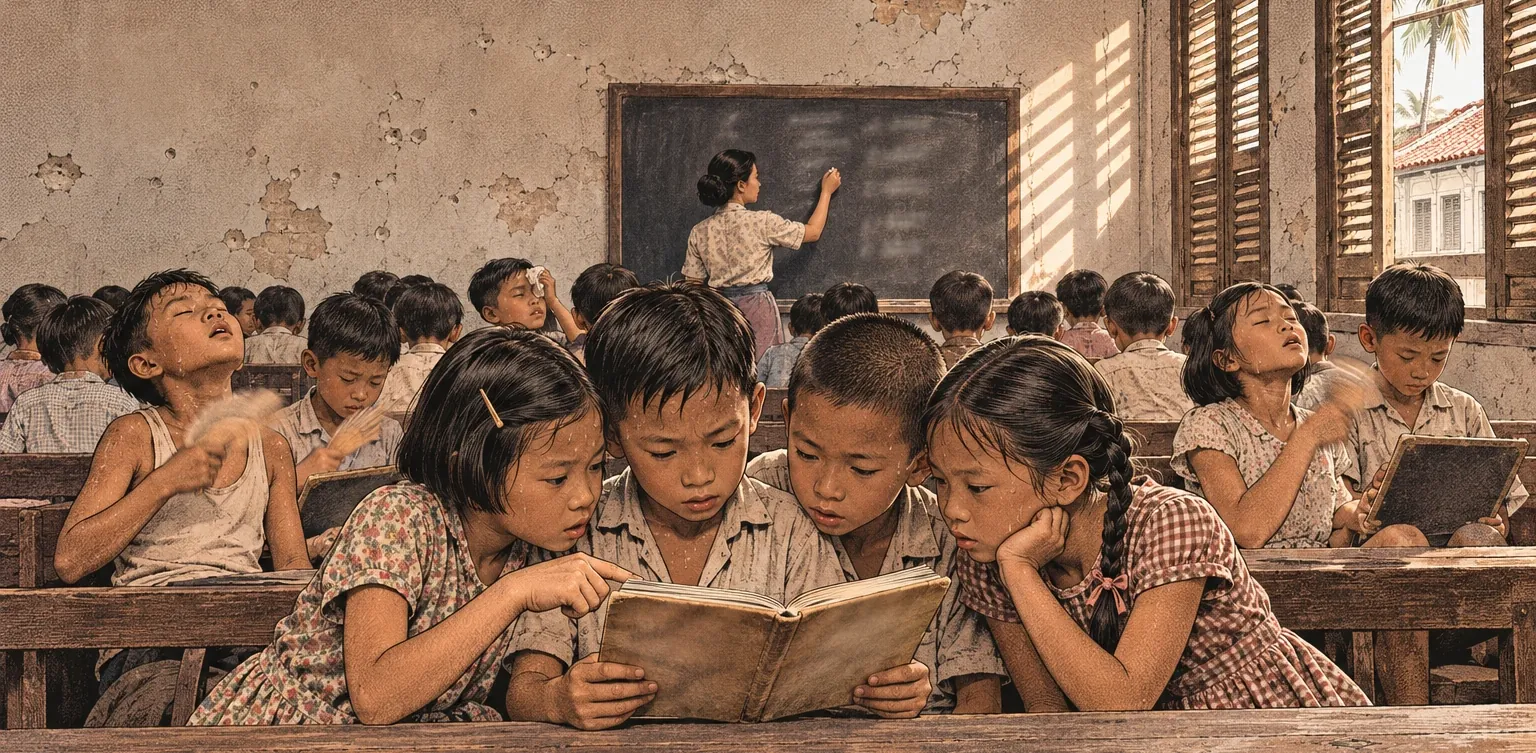
The crowded hot schoolroom seen along one bench: children fanning themselves with their hands, cracked slates on their laps, and four small children huddled over one shared, worn schoolbook; the teacher at the blackboard writes a column of sums.
Mei Lin, a six-year-old girl with a short bob and a straight fringe, kneels on the floorboards tracing a Chinese character on the boards with a small stick, explaining it earnestly; Swee Neo sits on the cane settee above her, leaning forward, listening and nodding.
Mei Lin, a six-year-old girl in a white tunic with a short bob and a straight fringe, stands holding her slate and gazes at the girl beside her, who bounces a real rubber ball.
IT WAS NOT A GOOD SCHOOL. THE ROOM WASHOT, THE SLATES WERE CRACKED, AND THEREWAS ONE BOOK FOR FOUR CHILDREN.BUT THE TEACHER KNEW HERSUMS.IN THE EVENINGS SHE DREW THE CHARACTERS ON THE FLOORWITH A STICK, AND EXPLAINED THEM TO HER MOTHER.Teacher says this stroke comesfirst.SWEE NEO, WHO KNEW THEM,LISTENED AND NODDED, ANDLET HER.MEI LIN DID NOT KNOW SHEWAS LUCKY. SHE KNEW THEGIRL NEXT TO HER HAD ABALL.
1946 · page 3
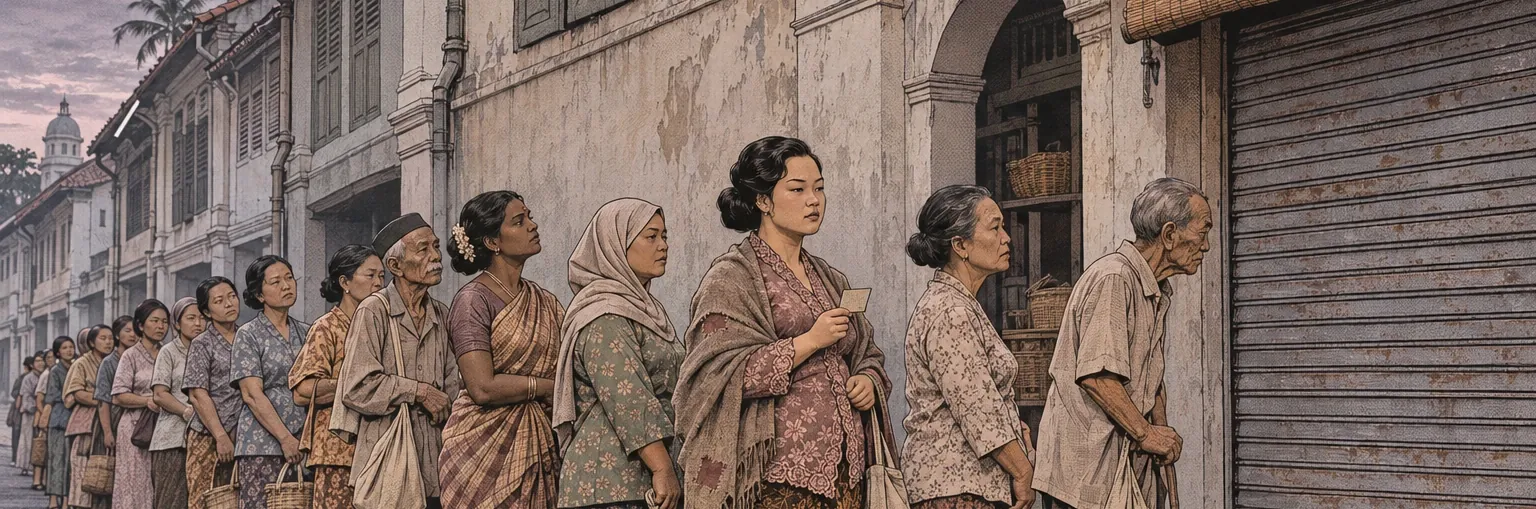
A long queue of women and old men stands in the dark lane before a closed ration-shop shutter; among them Swee Neo, in a borrowed shawl, holds a ration card in her hand.
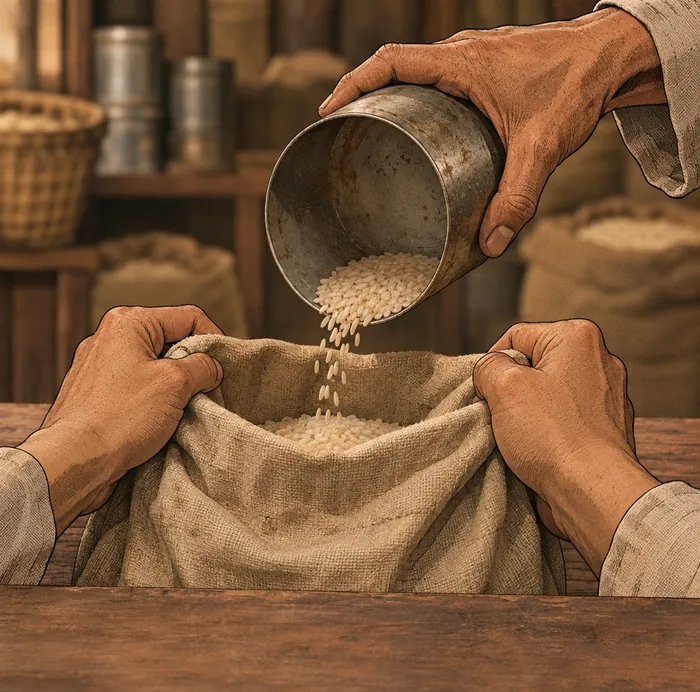
Close on a tin measure tipping rice into a cloth sack held open on a counter; the measure is visibly short of full.
A wiry boy of about twelve hoists a sack of rice onto his shoulder; Swee Neo presses a coin into his free hand.
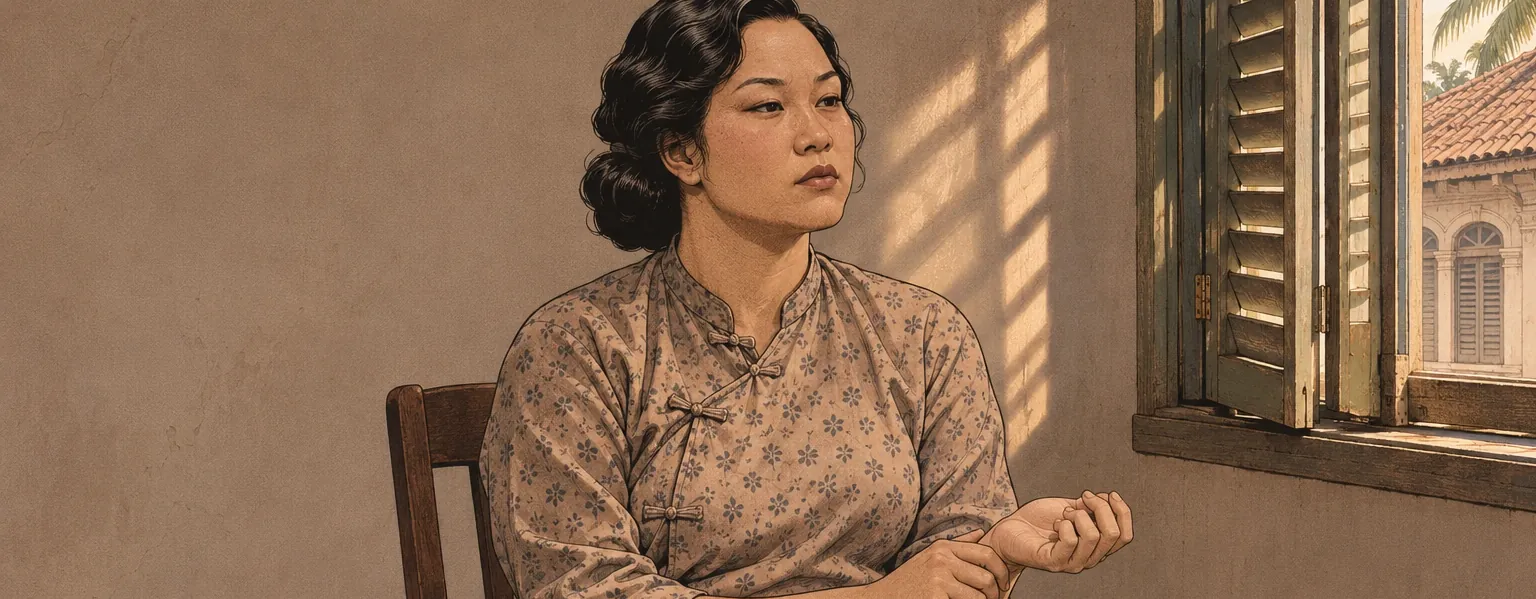
Swee Neo sits by the window with a half-finished hem laid down in her lap, rubbing her aching wrist, looking out; the long afternoon light lies across the floor.
Swee Neo stands just inside the open street door, holding a creased, travel-worn letter up to the light, reading it with complete stillness; a torn envelope in her other hand.
RICE WAS STILL ON THE RATION. THE QUEUE FOR IT FORMEDIN THE LANE BEFORE LIGHT.SWEE NEO STOOD IN IT MOSTWEEKS, IN A BORROWED SHAWL,WITH THE CARD IN HER HAND.IT CAME BY THE WEEK, IN AMEASURE THAT WAS NEVER QUITEWHAT THE CARD SAID.SHE WAS NOT STRONGENOUGH TO CARRY THESACK HOME. A BOYFROM THE NEXT HOUSEDID IT, FOR A COIN.SHE DID NOT TELLCHENG HUAT HOW MUCHSHE WAS PAYING HIM.SHE SEWED LITTLE THAT YEAR. SHE DID THEHEMS PEOPLE BROUGHT, BUT HAD STOPPEDLOOKING FOR MORE.WHEN HER WRIST HURT SHEPUT THE WORK DOWN, ANDTHEN THE AFTERNOON WASLONG.IN THE AUTUMN A LETTER CAME, CARRIED FROMTHE HARBOUR BY SOMEONE WHO HAD KNOWNSOMEONE WHO KNEW HER PEOPLE.IT HAD BEEN A LONG WHILE ON THE WAY. SHEREAD IT TWICE, STANDING IN THE DOORWAYFOR THE LIGHT.
1946 · page 4
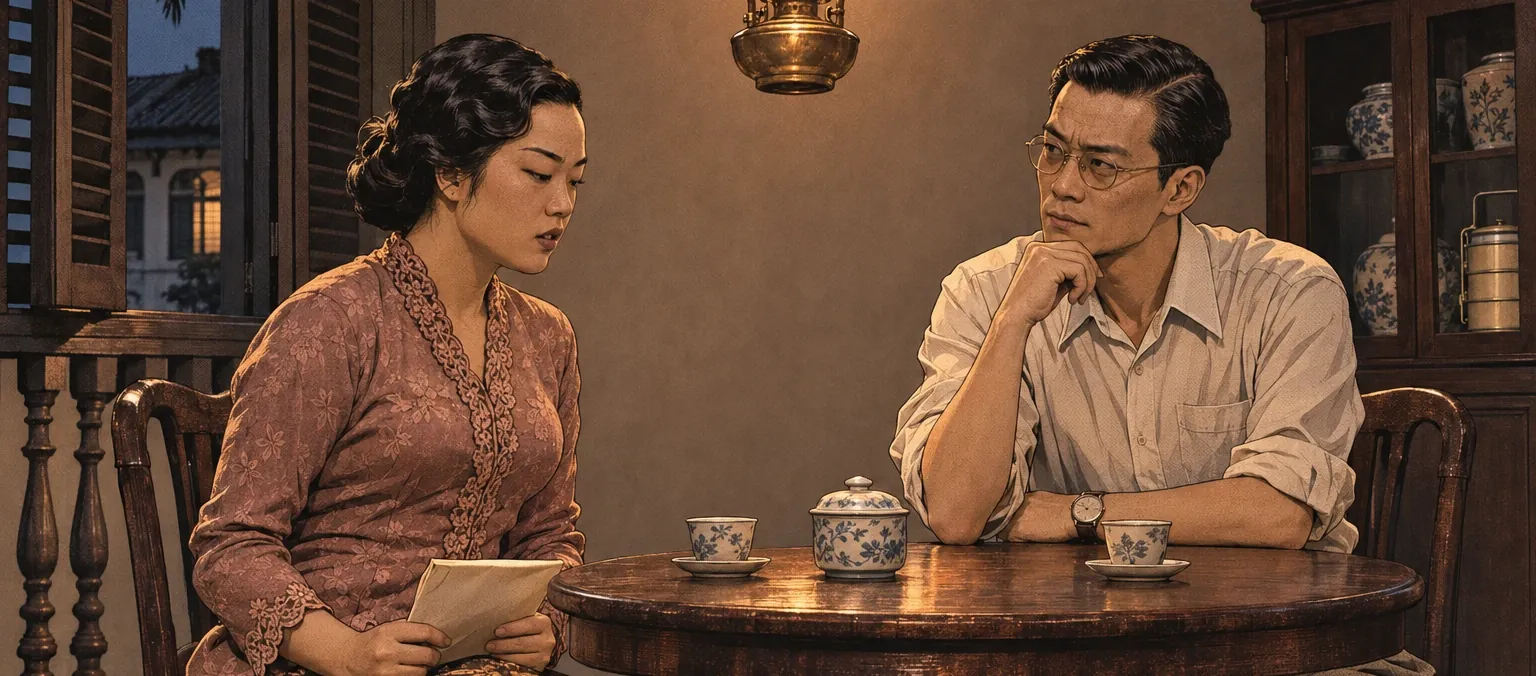
At the round table under the lamp Swee Neo speaks to Cheng Huat, the folded letter held in her lap, her eyes on the table; he listens closely.
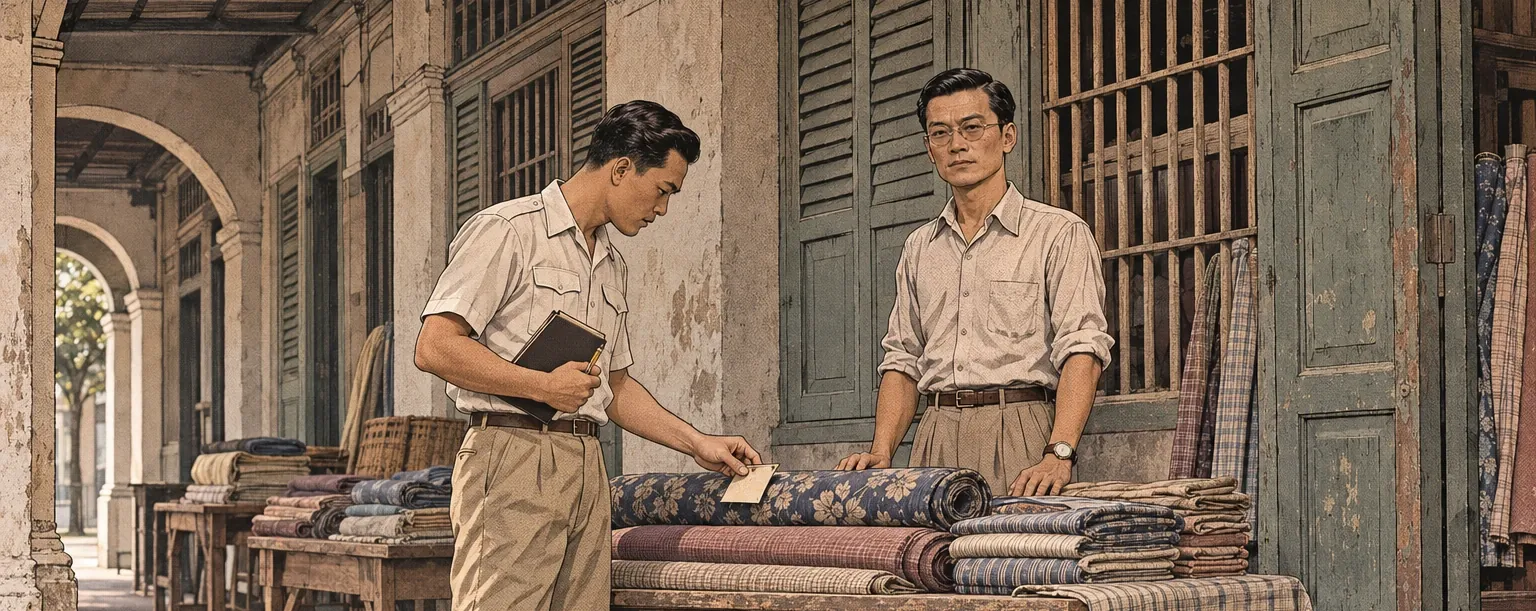
Cheng Huat, in a crisp white shirt, stands behind a trestle table well stocked with folded bolts of cloth, serving several customers at once; it is a busy table, but still only a table.
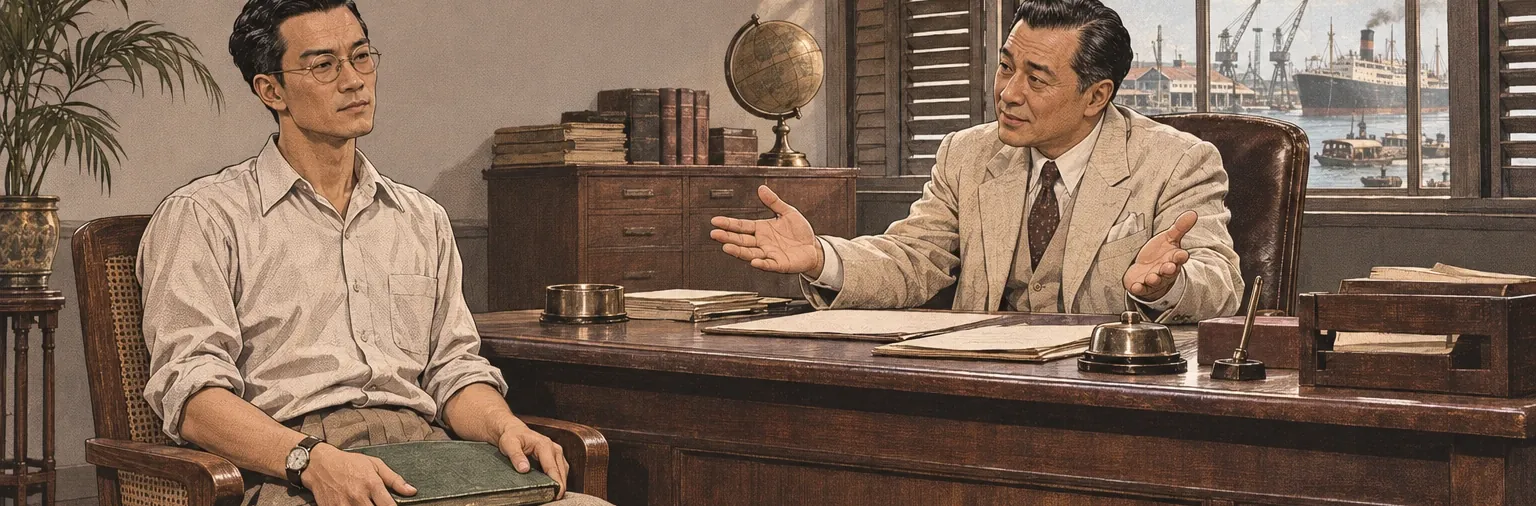
Cheng Huat sits across a broad desk from a shipping agent, the green cloth-covered ledger closed on his knees; the agent, a clean-shaven middle-aged man in a pale suit with no glasses, spreads his hands politely.
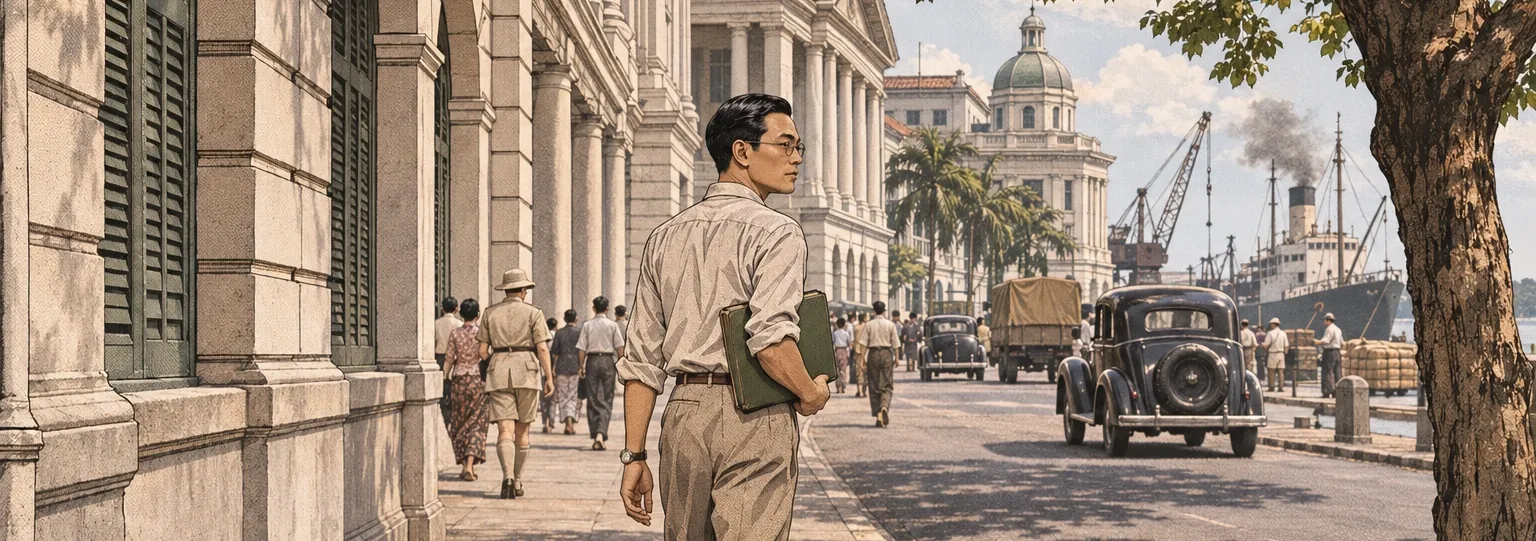
Cheng Huat walks away down the street alone, the green ledger under his arm, his face composed.
SHE TOLD CHENG HUATABOUT IT THAT EVENING,BUT NOT ALL OF IT, ANDNOT IN THE ORDER IT WASWRITTEN.IT WAS NOT THE NEWS SHEHAD WAITED FOR, NOR THENEWS SHE HAD FEARED. SHEHAD NO NAME FOR WHAT ITWAS.TAN CHENG HUAT, 38, FOUND HIS TABLE DID WELL THATYEAR. HE WANTED MORE THAN A TABLE.ALL SPRING HE CALLED ON THE MEN WHO MIGHTLEND AGAINST A NAME AND A LEDGER: THESHIPS' AGENTS, THE OLD SUPPLIERS.We'll certainly consider it,Mr Tan.But not yet.THE ANSWER WAS THE SAME EACH TIME. THE NAME HE HADBUILT HAD BEEN PUT TO SLEEP IN 1942, AND NOBODY YETKNEW IF IT WOULD WAKE.HE WENT ON SELLING ACROSS THETABLE.
1946 · page 5
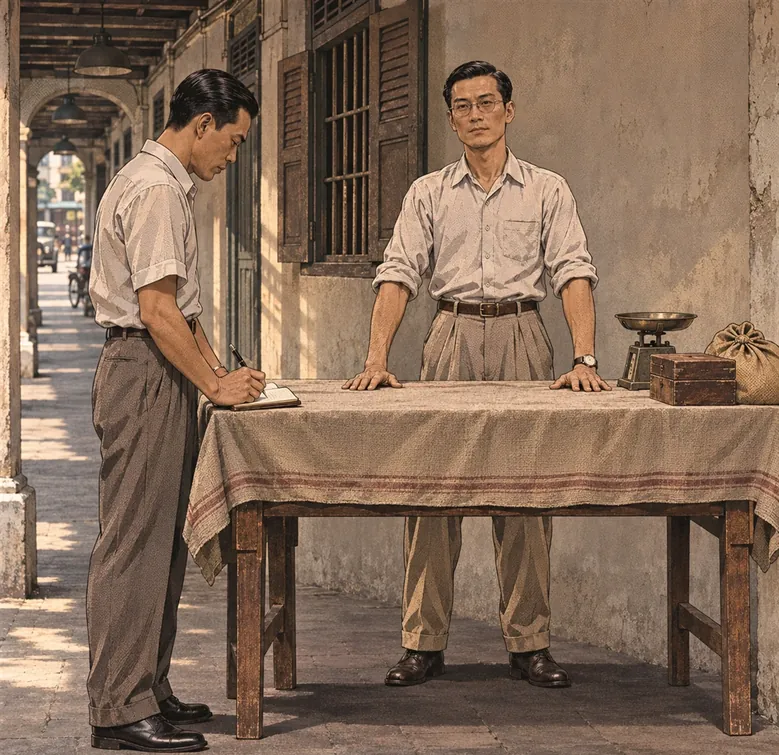
A price-control inspector, a clean-shaven local man in a white short-sleeved shirt and khaki shorts with a notebook and pencil, has stopped at Cheng Huat's table and is reading the small price card pinned to a bolt of cloth; Cheng Huat stands behind the table, still.
The inspector writes in his notebook against the edge of the table; across from him Cheng Huat stands silent, hands flat on the cloth.
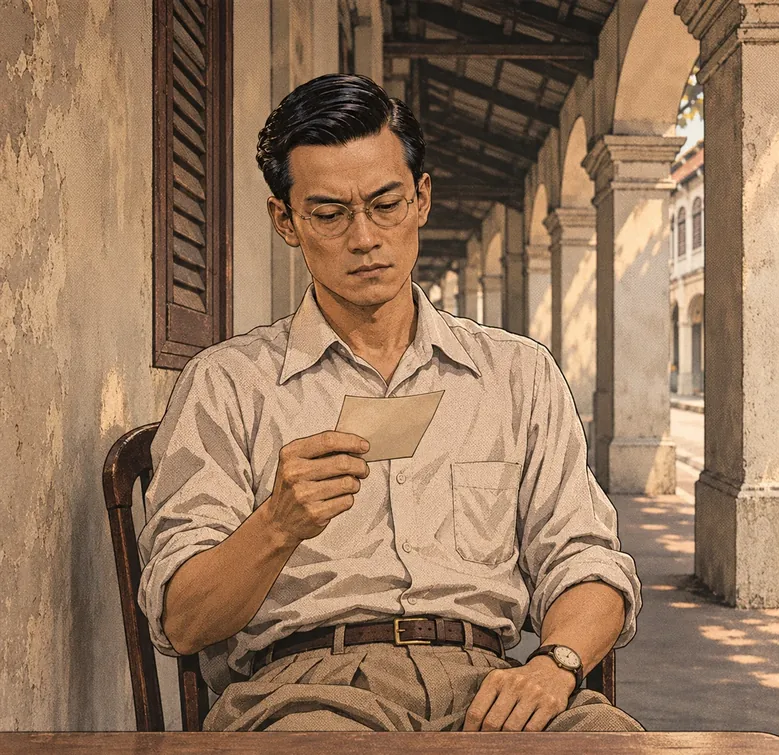
Cheng Huat alone at his table after the inspector has gone, looking down at a small official slip of paper in his hand, his face very still.
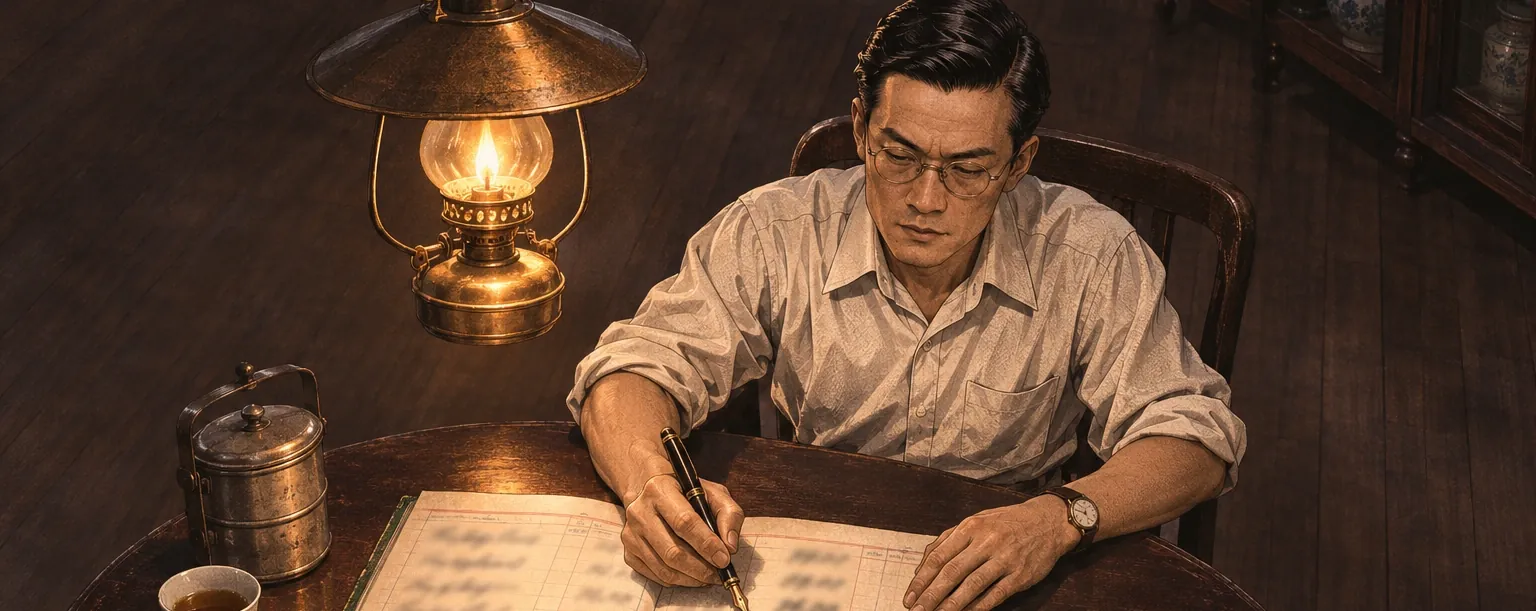
Looking down at the table: the large ledger with a green cloth cover lies open flat; a man's hand rules a firm line with a pen under a single sum in a new, separate column (handwriting unreadable); beside the ledger a short unanswered letter.
IN THE SUMMER AN INSPECTOR FROM THE PRICE-CONTROLOFFICE CAME DOWN THE ROW, WITH A BOOK AND A PENCIL.THE CLOTH WAS PRICED A LITTLE ABOVE THE POSTED FIGURE,AS EVERYONE'S WAS. THE POSTED FIGURE WAS A FICTION.CHENG HUAT, WHO HAD BEEN VERY CAREFUL ABOUTTHE FICTION FOR FOUR YEARS, SAID NOTHING. THEINSPECTOR WROTE IT DOWN.THE FINE WAS NOTLARGE. WHAT IT COSTHIM WAS THE IDEATHAT HE WAS A MANWHO DID NOT GETFINED.IN THE AUTUMN HE PAID IN ADVANCE FOR A CONSIGNMENTTHAT NEVER ARRIVED. THE AGENT AT THE OTHER END DID NOTREPLY.HE WROTE THE SUM IN ANEW COLUMN, HEADED WITHA WORD HE HAD ONCE USEDONLY FOR OTHER PEOPLE'SACCOUNTS, AND DREW ALINE UNDER IT.
1946 · page 6
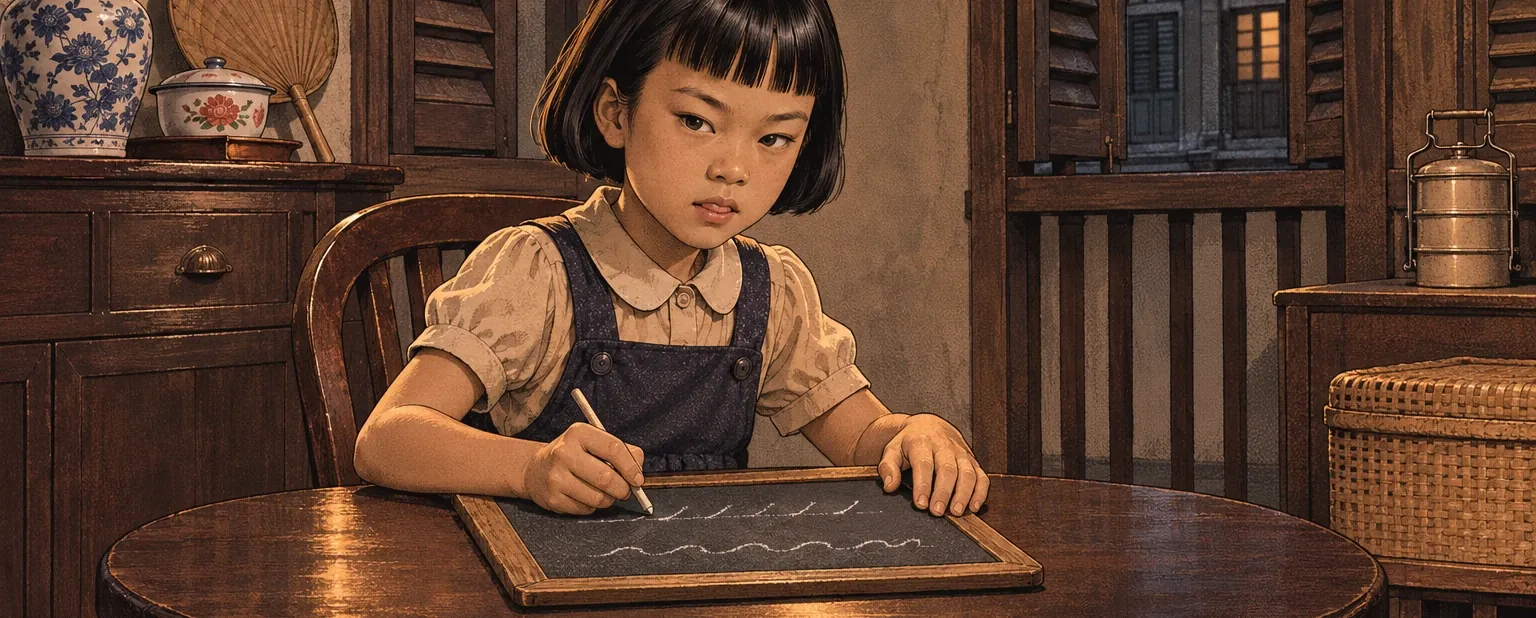
Mei Lin, a six-year-old girl with a short bob and a straight fringe, sits at the round table under the lamp, writing carefully on a slate with a slate pencil, tongue between her teeth; two short lines of writing on the slate (unreadable).
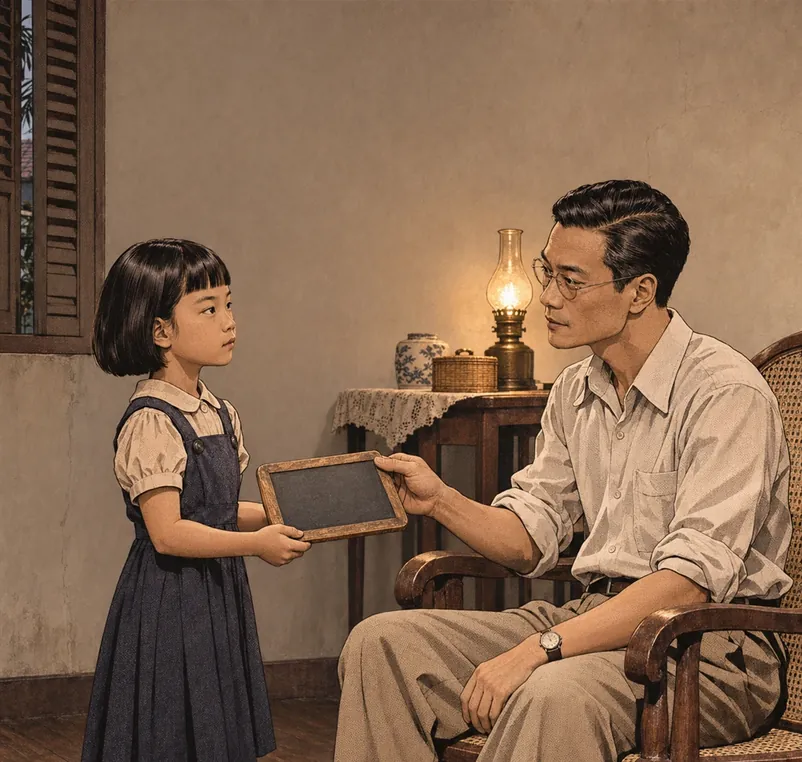
Mei Lin, a six-year-old girl with a short bob and a straight fringe, holds her slate up in both hands to her father, who sits in a chair and takes it.
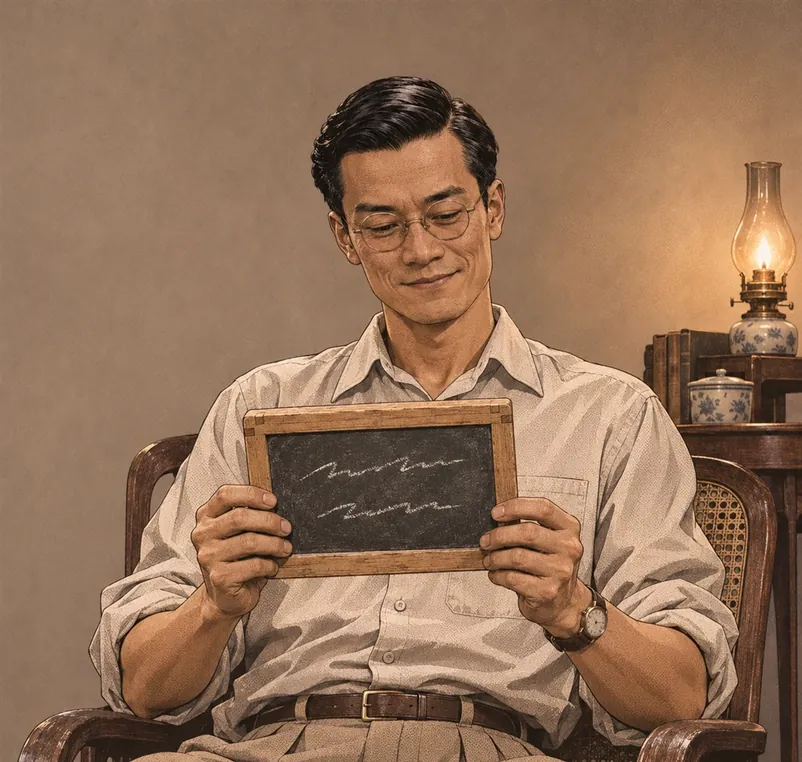
Cheng Huat sits holding a small old-fashioned school slate in both hands, tilted toward the viewer so its face shows: a grey-black slate in a light, unpainted wooden frame with square corners, two short lines of white chalk writing on it (unreadable). He studies it through his spectacles for a long time, a slow smile beginning.
ON THE LAST NIGHT OF THE YEARMEI LIN WROTE HER NAME ON HERSLATE, IN CHINESE.THEN, BECAUSE THETEACHER HAD TOLD HER TOPRACTISE, SHE WROTE ITIN THE OTHER SCRIPT ASWELL.SHE SHOWED IT TO HER FATHER.Papa. Look.HE LOOKED AT IT FOR A LONG TIME.It's well done.AND HE MEANT IT.
The year in money. Household income about $1,114 a month, against a peer median of $150: 7.4 times the median (nominal dollars; a model estimate).
The real 1946

Singapore in 1946 is under the British Military Administration until 1 April, when it becomes a separate Crown Colony. Food is still short and rationed; rice queues, price controls and a flourishing black market continue, and unrest and strikes mark the year.

More on Singapore in 1946 ▸

Behind the dice How likely was each thing that happened? (Spoilers)

Nothing in The Dice Decides is chosen by a writer. Each person's year is a set of rolls, weighted by their stats and their times; the story is written afterwards to fit what the dice decided.

WhoWhat the dice decidedResultChance
Tan Mei LinMei Lin starts at a small school in a neighbour's front room.small school8%
Tan Cheng HuatThe ships' agents and old suppliers are polite: not yet. No proper firm.no75%
Tan Cheng HuatA price-control inspector writes him down for cloth above the posted price.yes14%
Tan Mei LinThe rice queue in the lane before light.rice queues16%
Tan Cheng HuatA prepaid consignment never arrives; a new column in the ledger.bad news11%
Lim Swee NeoA long-delayed letter about her people: neither what she hoped nor what she feared.kin news9%
Tan Cheng HuatHis table does well as the ships and stock come back.yes49%
Lim Swee NeoShe sews little and stops looking for more.no70%
Tan Mei LinA quiet year at home: characters drawn on the floor for her mother.quiet34%
Tan Mei LinNo serious illness for Mei Lin.no98%
Tan Mei LinPrices and shortages, but the household is not squeezed further.no88%
Tan Mei LinMei Lin alive at the year's end.no99%
Tan Cheng HuatCheng Huat is not seriously ill.no95%
Tan Cheng HuatCheng Huat survives the year.noover 99%
Lim Swee NeoSwee Neo is not seriously ill.no93%
Lim Swee NeoSwee Neo alive at the year's end.noover 99%

Chances are the simulation's model assumptions, not historical statistics.

Household income as a multiple of the peer median, 1941–1946
0×4×8×12×peer median19451946
Show as a table
YearHousehold a monthPeer medianMultiple
1941$504$4212.0×
1942$82$422.0×
1943$148$423.5×
1944$204$424.9×
1945$815$1206.8×
1946$1,114$1507.4×

Nominal dollars; the engine's model estimate, the same figure as each issue's money line.

The chapter in prose

1946: The Front Room School

In 1946, the first full year of peace, six-year-old Mei Lin starts school in a neighbour's front room. Tan Cheng Huat's trade grows, but he does not manage to reopen a proper firm, is fined by a price-control inspector, and loses a consignment he had already paid for. Lim Swee Neo queues for rice, sews little, and receives news at last of a relative's household. Nobody in the family is seriously ill.

The Front Room School

The school was not in a school. It was in the front room of a house three doors down, in a street whose shophouses still had shell-marks on the plaster, and it was run by a teacher who had taught before the war and had been, the street said, a clerk in the Occupation. Nobody asked her about that. She had thirty children on benches and a blackboard borrowed from a church. The first week she taught them to stand and say good morning.

Mei Lin was six, and could write her own name. She was the smallest girl in her row. Her mother walked her to the door on the first morning, in a clean tunic that had been let out at the hem, and stood in the lane until the door closed behind her.

It was not a good school. The room was hot. The slates were cracked, and there was one book for four children. But there was a teacher who knew her sums, and a row of children who were also learning to sit still, and at home she sat in the evenings with a small stick in her hand and drew the characters on the floor and explained them to her mother. Swee Neo, who knew them, listened and nodded and let her.

Mei Lin did not know she was lucky. She knew the girl next to her had a ball.

The Rice Queue

Rice was still on the ration. It came by the week, in a measure that was never quite what the card said, and the queue for it formed in the lane before light. Swee Neo stood in it most weeks, in a borrowed shawl, with the card in her hand. She was not strong enough to carry the sack home. A boy from the next house did it for her, for a coin, and she did not tell Cheng Huat how much she was paying him.

She sewed little that year. People still brought her hems and she did them, but she had stopped looking for more. When her wrist hurt she put the work down, and when the work was down the afternoon was long.

The letter came in the autumn, carried from the harbour by someone who had known someone who knew her people. It had been a long while on the way. She read it twice, standing in the doorway to catch the light. She told Cheng Huat about it that evening, but not all of it, and not in the order it was written. It was not the news she had waited for, and it was not the news she had feared. It was somewhere in between, and she did not have a name for that.

The Inspector

Cheng Huat's table did well that year, and he wanted more than a table. He spent the spring calling on the men who might lend against a name and a ledger: agents of the ships, the old suppliers who had come back. They were polite. They said they would consider it, and the answer, when it came, was the same each time: not yet. The name he had built had been put to sleep in 1942, and no one yet knew whether it would wake. He went on selling across the table.

In the summer an inspector from the price-control office came down the row, with a book and a pencil. He stopped at the table. The cloth was priced a little above the posted figure, as everyone's was, because the posted figure was a fiction. Cheng Huat, who had been very careful about the fiction for four years, said nothing. The inspector wrote it down. The fine was not large. What it cost him was the idea that he was a man who did not get fined.

In the autumn he paid in advance for a consignment that never arrived. It had gone on a ship, or it had not gone on a ship; the agent at the other end did not reply. He wrote the sum into the book in a new column, headed with the word he had once used only for other people's accounts, and drew a line under it.

On the last night of the year Mei Lin wrote her name on the slate, in Chinese, and then, because the teacher had told her to practise, in the other script as well. She showed it to her father. He looked at it for a long time, and said it was well done, and meant it.