The Merchant's Daughter

Issue #6 · 1945: The Quiet After

1945

In 1945 the Japanese Occupation ends. Early in the year soldiers search the Tan house and frighten Lim Swee Neo, who is already weakened by hunger, and her sewing falls off. When Japan surrenders in August, the street comes together, and when the British return Tan Cheng Huat is among the first to trade again. Five-year-old Mei Lin has a quiet year, and all three of them are alive when it ends.

A work of fiction set in real history. The characters are invented; the historical events are real and sourced.

Previously, in 1944…

In 1944, the Tan family's fourth year of war, the street holds together. Neighbours share what they have and warn one another of what they hear, and an older neighbour is kind to four-year-old Mei Lin. Tan Cheng Huat's small trading holds up, and he and Lim Swee Neo grow closer in the evenings. Swee Neo's sewing and cooking bring in more custom, but she eats last and hunger leaves her weaker. Nobody in the house dies or falls seriously ill, and the military police pass the door.

1945
The Quiet After
Tan Mei Lin, 5
the child of the house
Tan Cheng Huat, 37
her father, a merchant
Lim Swee Neo, 30
her mother
1945 · page 1
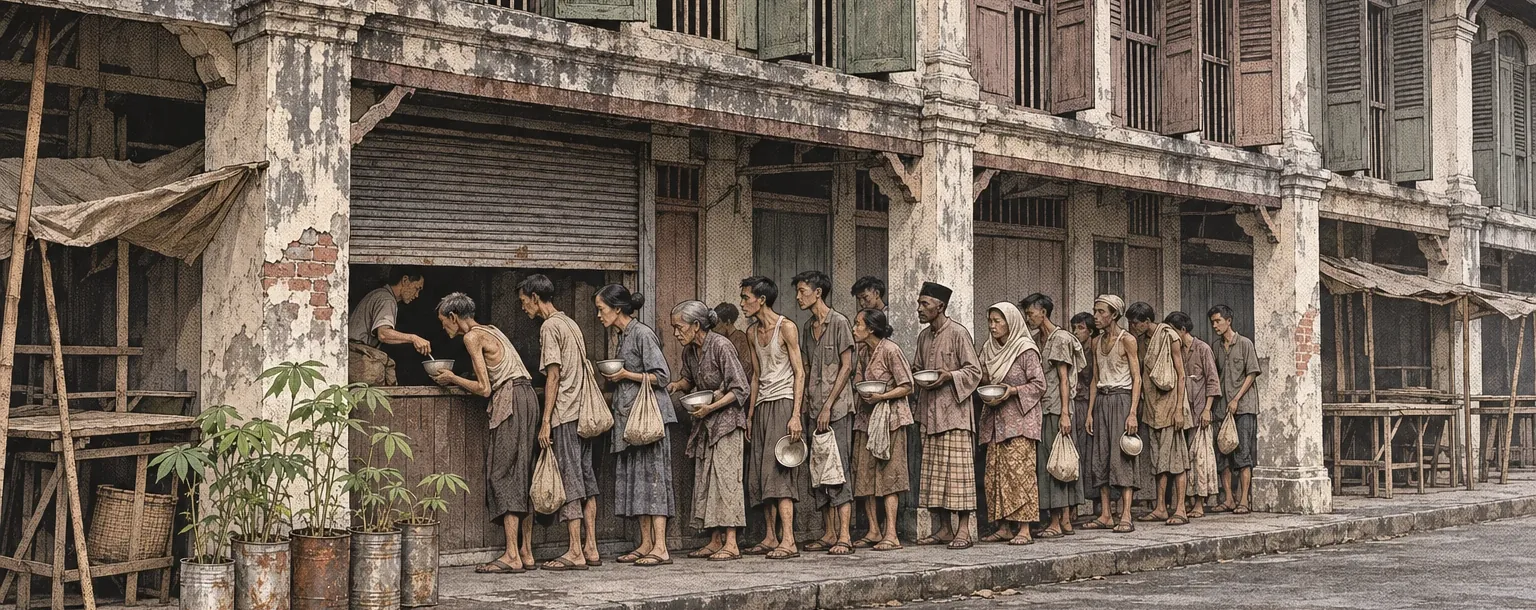
The hungriest year of the Occupation: a long queue of very thin residents with empty bowls and cloth bags waits at a ration shop's half-open shutter; the stalls along the five-foot way are bare; tapioca grows in tins.
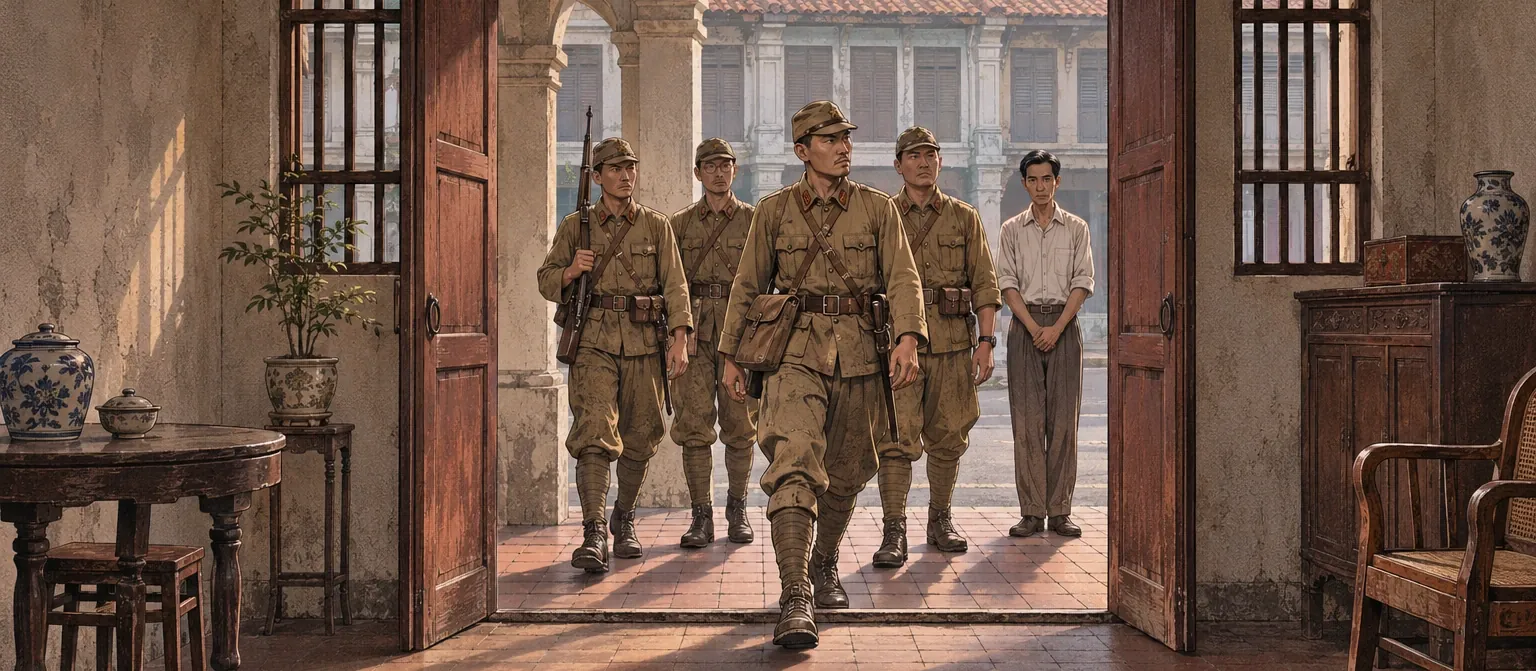
Four Japanese soldiers in worn khaki stand at the shophouse's open street door, the first already stepping inside; behind them a local man in a civilian shirt, the translator, waits with his hands folded.
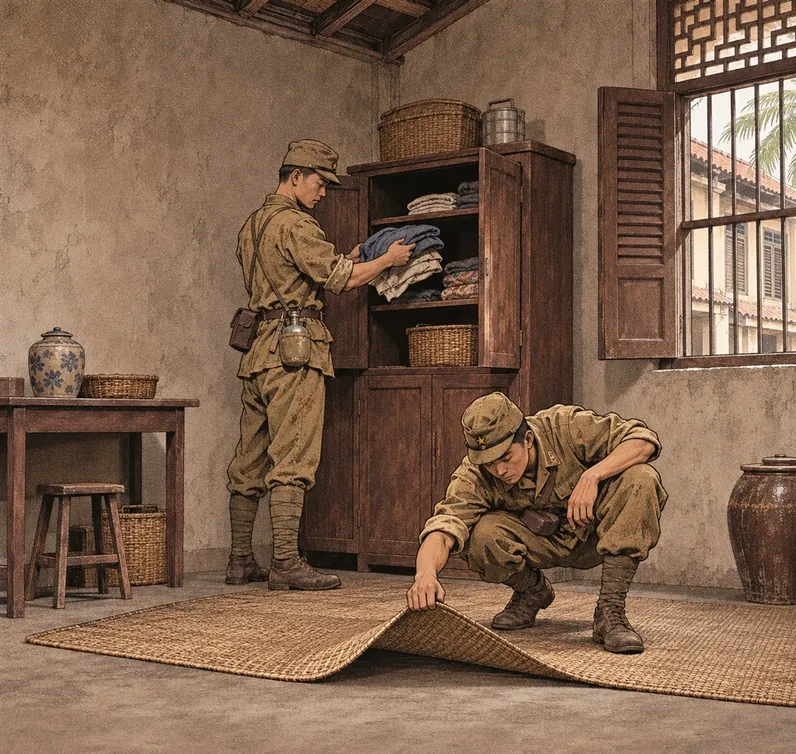
Two Japanese soldiers search a room: one pulls folded clothes out of an open wooden cupboard, the other lifts a rattan floor mat to look beneath it; nothing is broken.
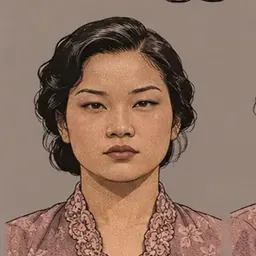
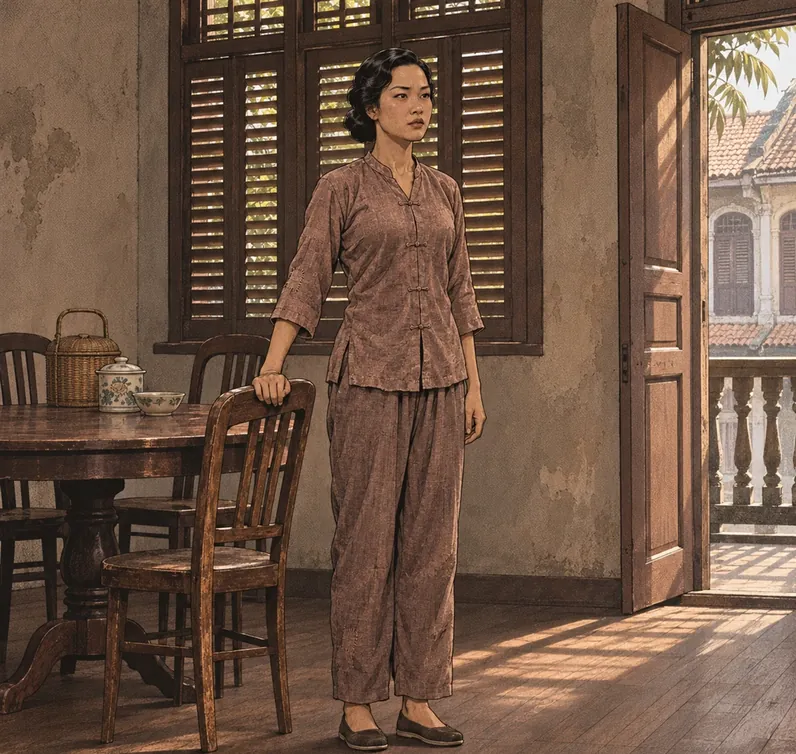
Swee Neo, thinner than before, stands very still in the front room with one hand gripping the back of a wooden chair, watching a doorway; her face is set.
1945: THE LAST YEAR OF THE OCCUPATION, AND THEHUNGRIEST.RATIONS WERE ALMOSTNOTHING. PRICES WEREBEYOND REASON.THEY CAME TO THE HOUSE EARLY IN THE YEAR, AT AN HOURWHEN NOBODY EXPECTED ANYONE. FOUR OF THEM, AND A MANWHO TRANSLATED.THEY DID NOT SAY WHAT THEY WERE LOOKINGFOR.THEY WENT THROUGH THE ROOMS ONE AT A TIME,TURNING OUT THE CUPBOARDS AND LIFTING THE MATS.THEY DID NOT BREAKANYTHING THAT WAS NOT INTHE WAY.LIM SWEE NEO, 30,STOOD IN THE FRONTROOM WITH HER HANDON THE BACK OF ACHAIR.SHE HAD STOPPEDTRUSTING HER KNEES.
1945 · page 2
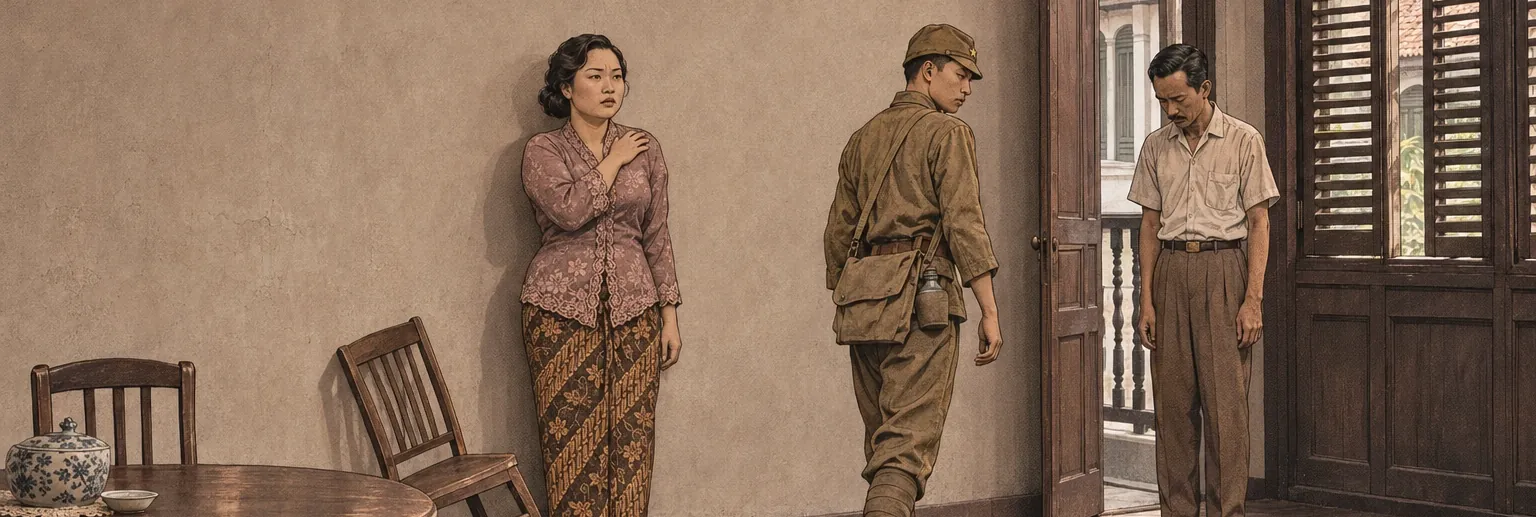
The moment after: Swee Neo stands with her back against the plastered wall, one hand pressed to her shoulder, shaken and very still, a wooden chair knocked askew beside her; a young Japanese soldier of about twenty is already turning away from her toward the door, his face indifferent; the moustached translator stands several steps away by the door, looking at the floor. No one is being struck in the picture.
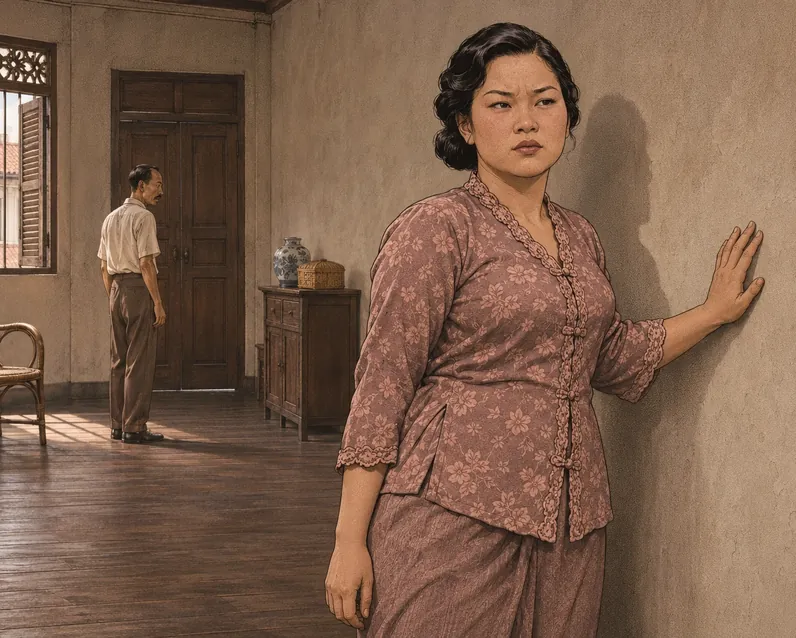
Swee Neo with her back against the wall, one hand flat on it, staring past the camera, alone in the foreground; several steps away across the room, near the door, the moustached translator, half-turned away, says something without looking at her. He does not touch her or stand close.
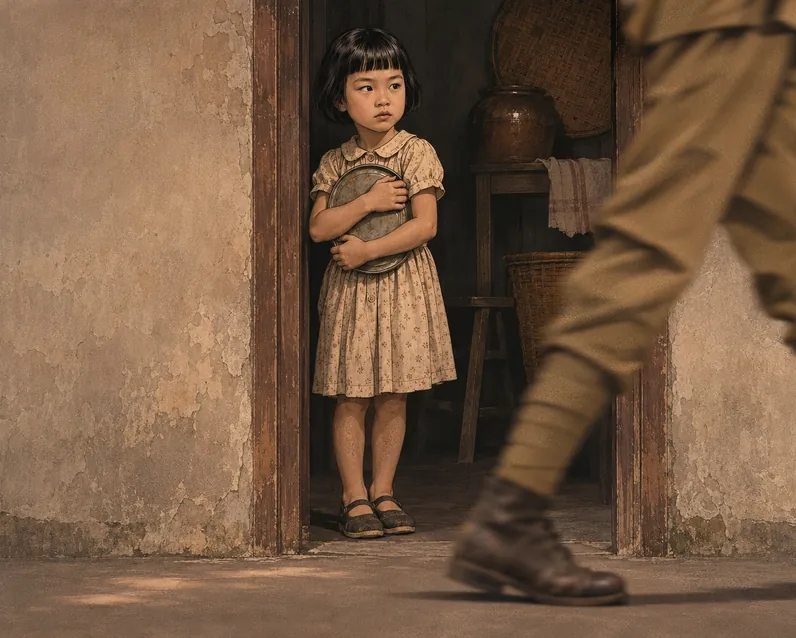
Mei Lin, a five-year-old girl in a simple cotton dress with a short bob and a straight fringe, stands in a dim doorway clutching an old tin lid to her chest with both hands, watching wide-eyed; in the foreground the blurred khaki legs of a soldier pass.
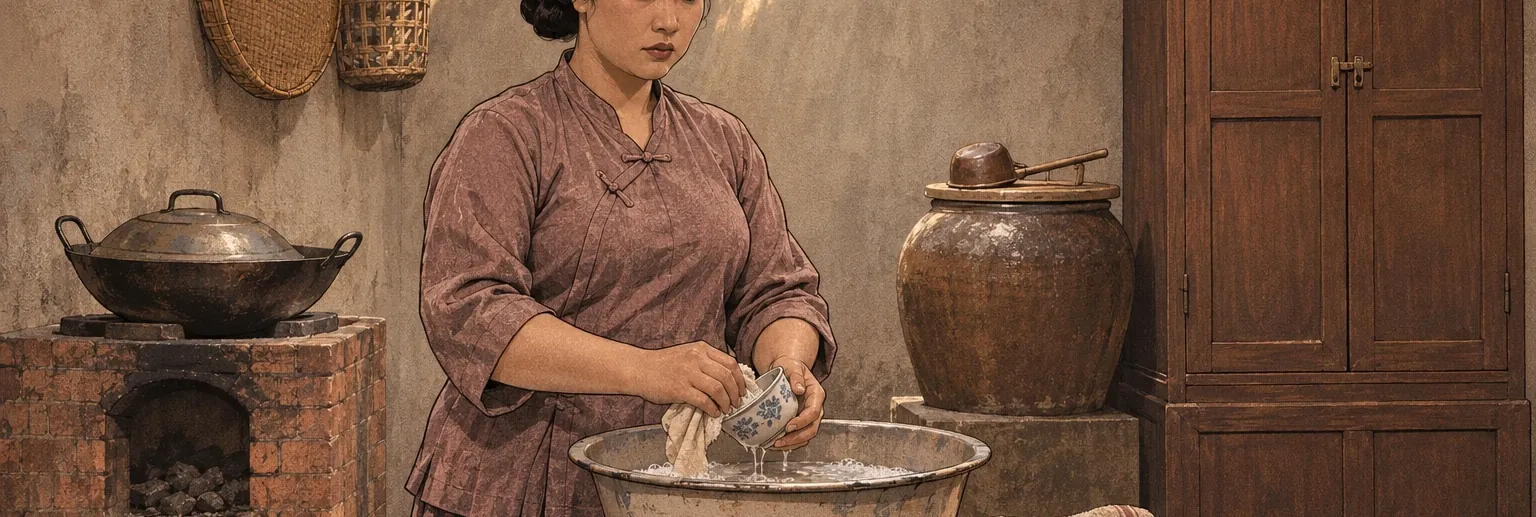
Swee Neo alone in the quiet kitchen, washing a cup in a basin; the cupboard doors behind her are closed again, the things put back; her movements are slow and careful.
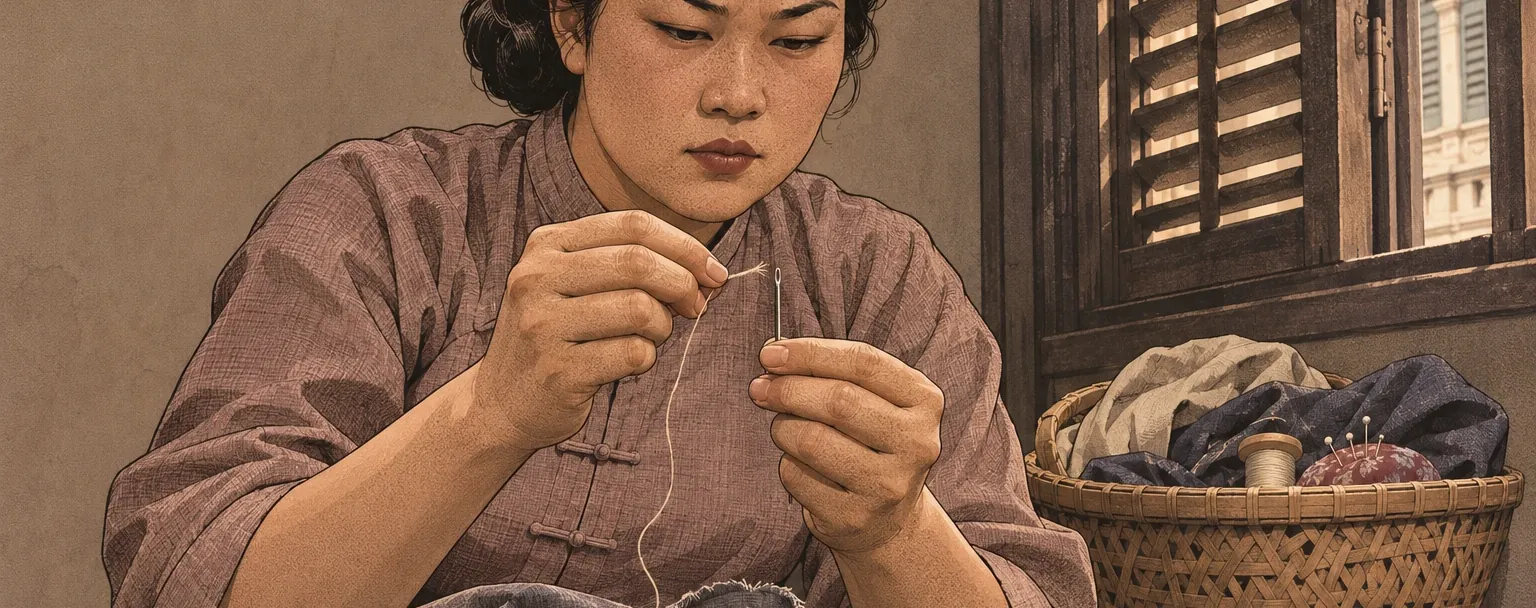
Close on Swee Neo's hands trying to thread a needle over a garment's unfinished hem, the thread wavering short of the eye; a basket of untouched mending beside her.
A YOUNG ONE, WHO MIGHT HAVEBEEN TWENTY, CAME BACK FROM THEKITCHEN AND LOOKED AT HER FOR AWHILE.THEN HE PUSHED HER ASIDEWITH HIS FOREARM, HARDENOUGH THAT SHE HIT THEWALL.THE TRANSLATOR SAID ASENTENCE IN MALAY. SHE DIDNOT UNDERSTAND THE WORDS.SHE UNDERSTOOD HIM.MEI LIN, 5, WATCHEDFROM THE DOOR OF THEBACK ROOM, WITH THETIN LID IN BOTHHANDS.NOBODY LOOKED ATHER.WHEN THEY HAD GONE, SWEE NEOWENT ON STANDING WHERE SHE WASFOR A GOOD WHILE.THEN SHE PUT THECUPBOARDS BACK, ANDWASHED THE CUPS THAT HADBEEN MOVED.SHE SEWED LESS AFTER THAT. SHETOOK THE HEMS, AND KEPT THEM AWEEK PAST THE DAY SHE HADPROMISED.HER HANDS WERE NOTSTEADY, AND SHE KNEW IT,AND SO DID THEY. IT WASA LONG TIME BEFORE THECUSTOM CAME BACK.
1945 · page 3
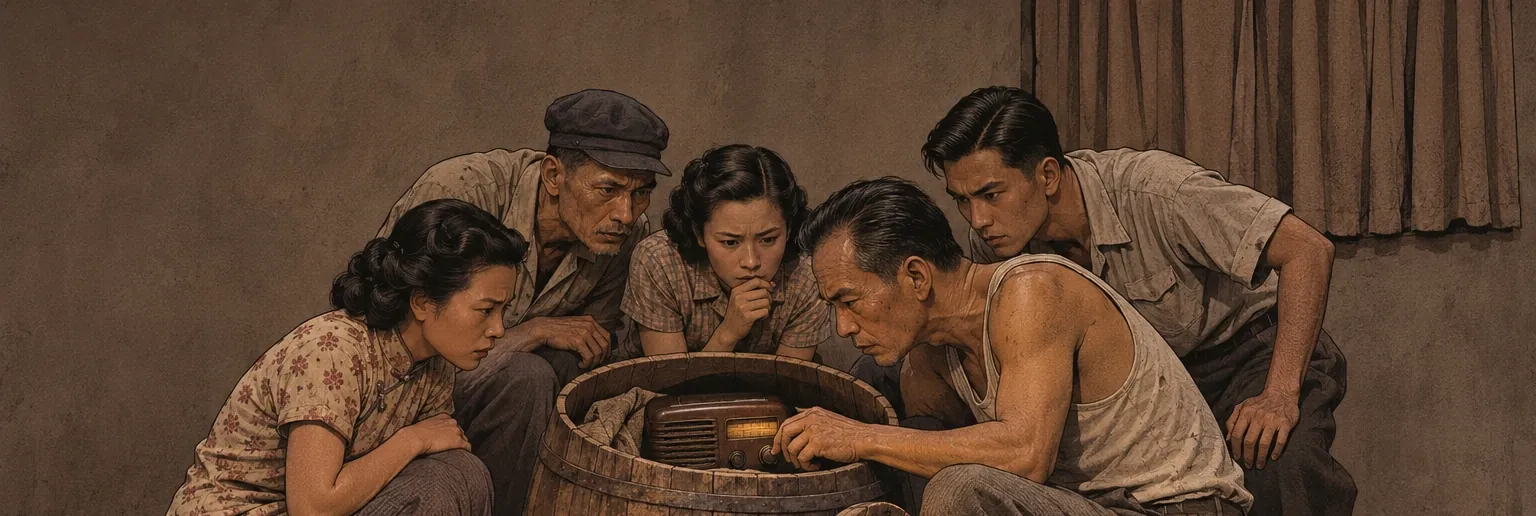
In a dim back room with the curtains drawn, a middle-aged man crouches by a wooden barrel with its lid off, a small radio set hidden inside it; three or four neighbours lean in close to listen, faces tense.
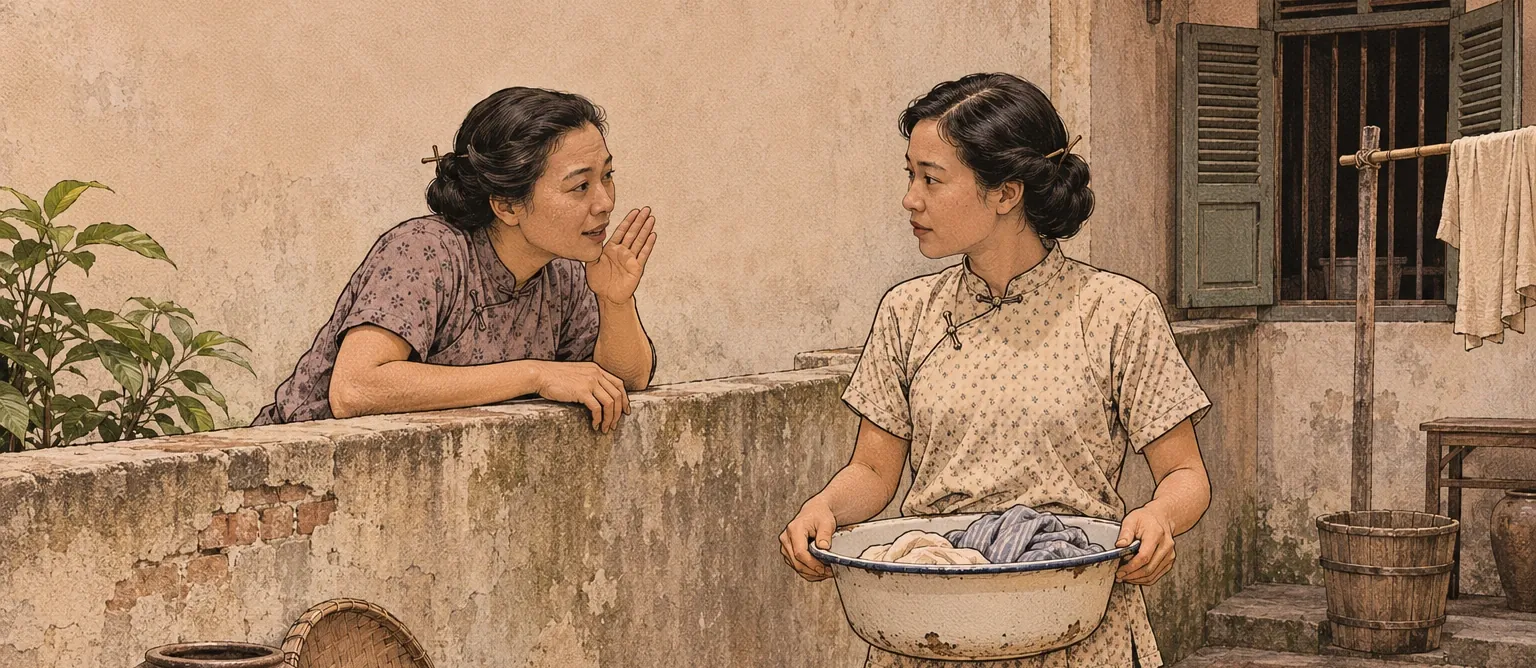
A neighbour woman leans over a low back-yard wall and speaks softly to another woman on the other side, who has stopped with a basin in her hands.
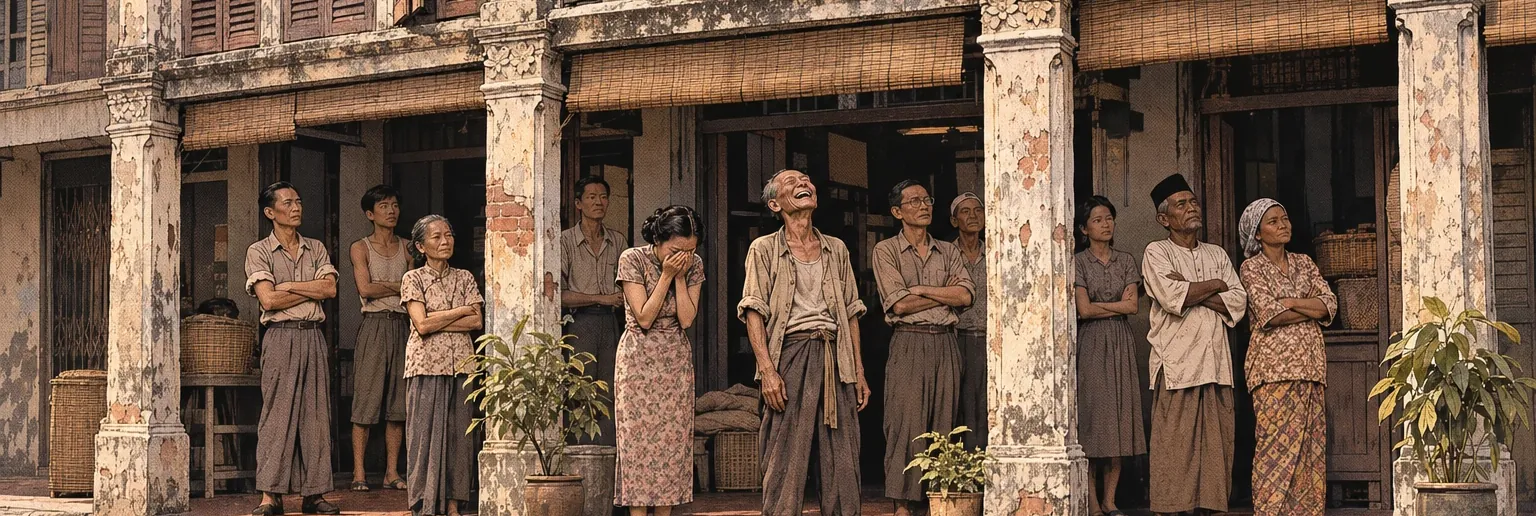
The shophouse street after the news: one woman weeps into her hands, an old man laughs with his head back, and most of the residents simply stand in their doorways, arms folded, watching the empty road.
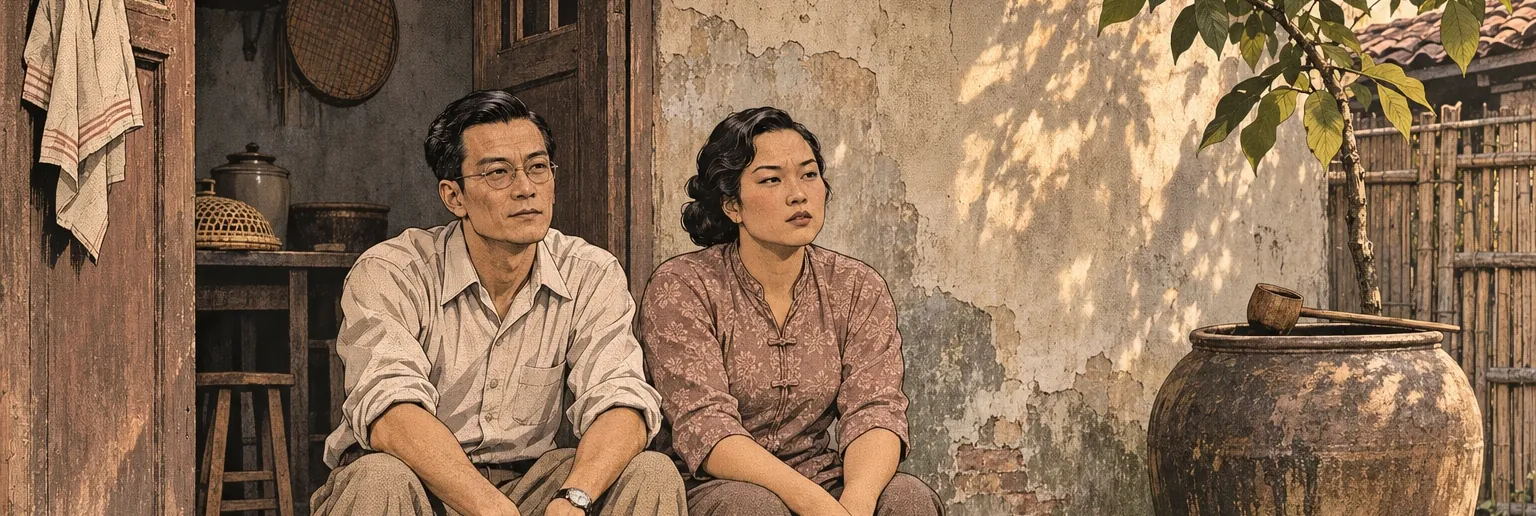
Cheng Huat sits on the back step with his hands between his knees; Swee Neo has just sat down beside him, close, shoulders almost touching; neither speaks; they look out at the yard.
15 AUGUST 1945. THE NEWS CAMEON A RADIO A NEIGHBOUR HADHIDDEN IN A BARREL, IN A BACKROOM WITH THE CURTAINS DRAWN.IT CAME INTO THE STREET THE WAYNEWS HAD COME FOR NEARLY FOURYEARS: CALLED SOFTLY ACROSS AWALL.Japan has accepted the terms.It's over.SOME OF THE STREET WEPT. SOME LAUGHED. MOST OF THEMWAITED TO SEE WHAT WOULD HAPPEN NEXT.THE BRITISH DID NOT COME UNTIL SEPTEMBER. IN THE WEEKSBETWEEN, NOBODY WAS SURE WHO THE STREET ANSWERED TO.IN THE TAN HOUSE NOBODYSAID VERY MUCH. CHENGHUAT SAT DOWN ON THEBACK STEP, AS HE HADAFTER THE SCREENINGCENTRE.SWEE NEO SAT DOWN BESIDEHIM, WHICH SHE HAD NOTDONE IN YEARS.
1945 · page 4
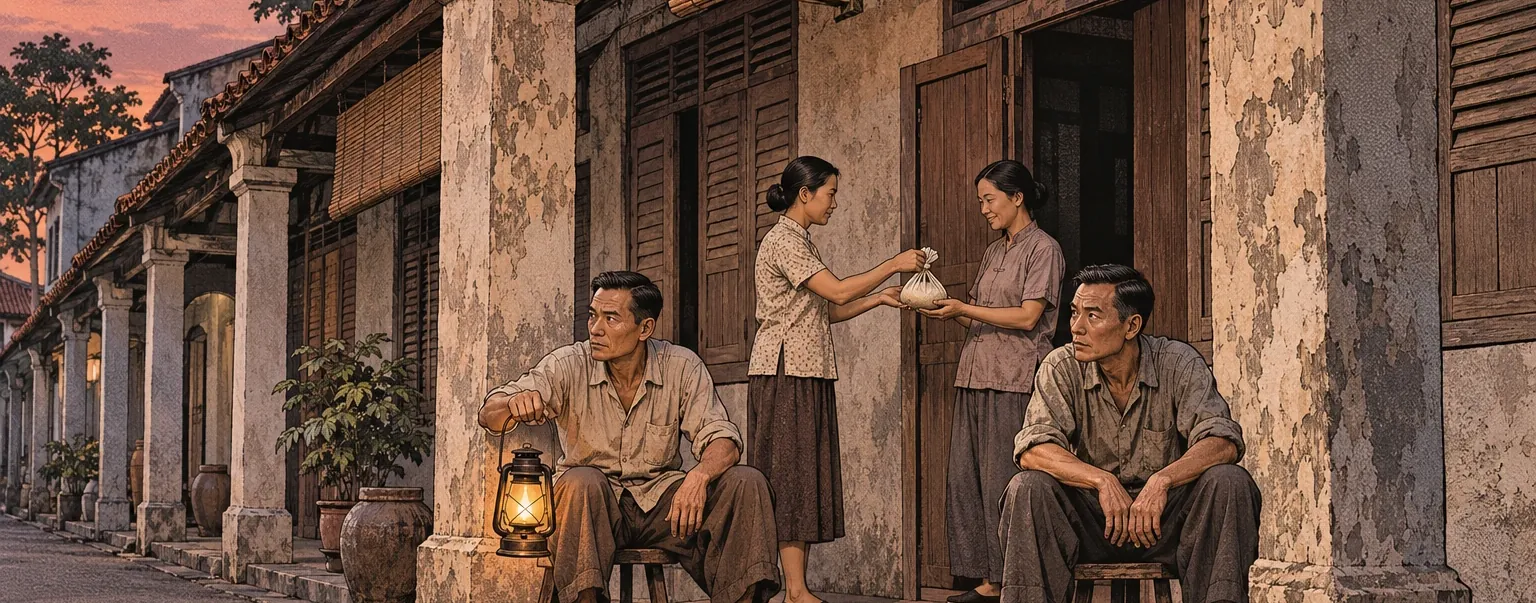
At the head of the lane two neighbour men keep watch on stools, one with a lantern; behind them along the five-foot way a woman hands a twist of cloth holding a little rice to a neighbour at her door.
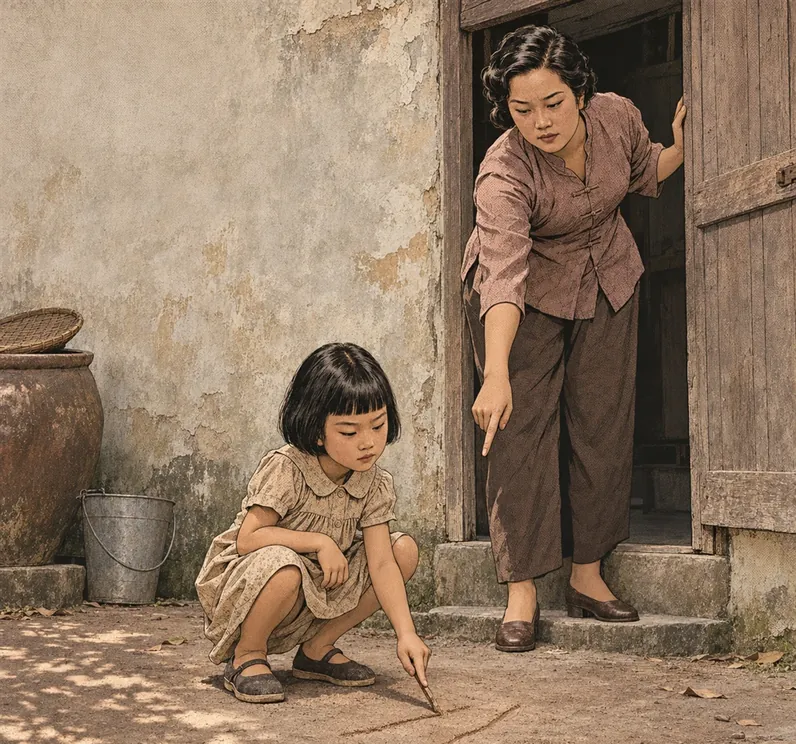
Mei Lin, a five-year-old girl in a simple cotton dress with a short bob and a straight fringe, crouches drawing Chinese characters in the dust with a stick; Swee Neo stands in the back doorway, pointing at a stroke.
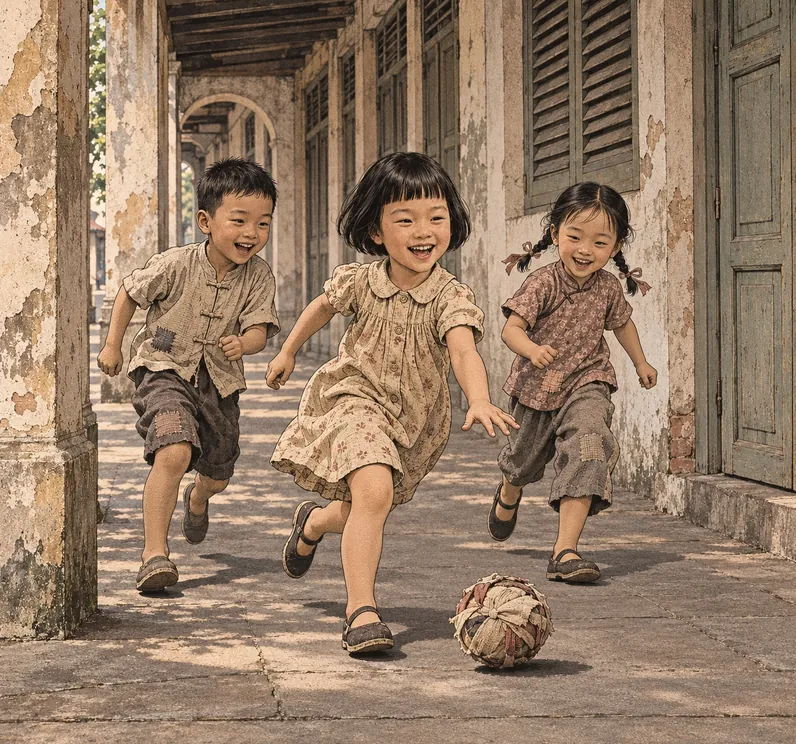
Mei Lin, a five-year-old girl in a simple cotton dress with a short bob and a straight fringe, runs laughing after a lumpy ball made of knotted rags, with two children from the next house.
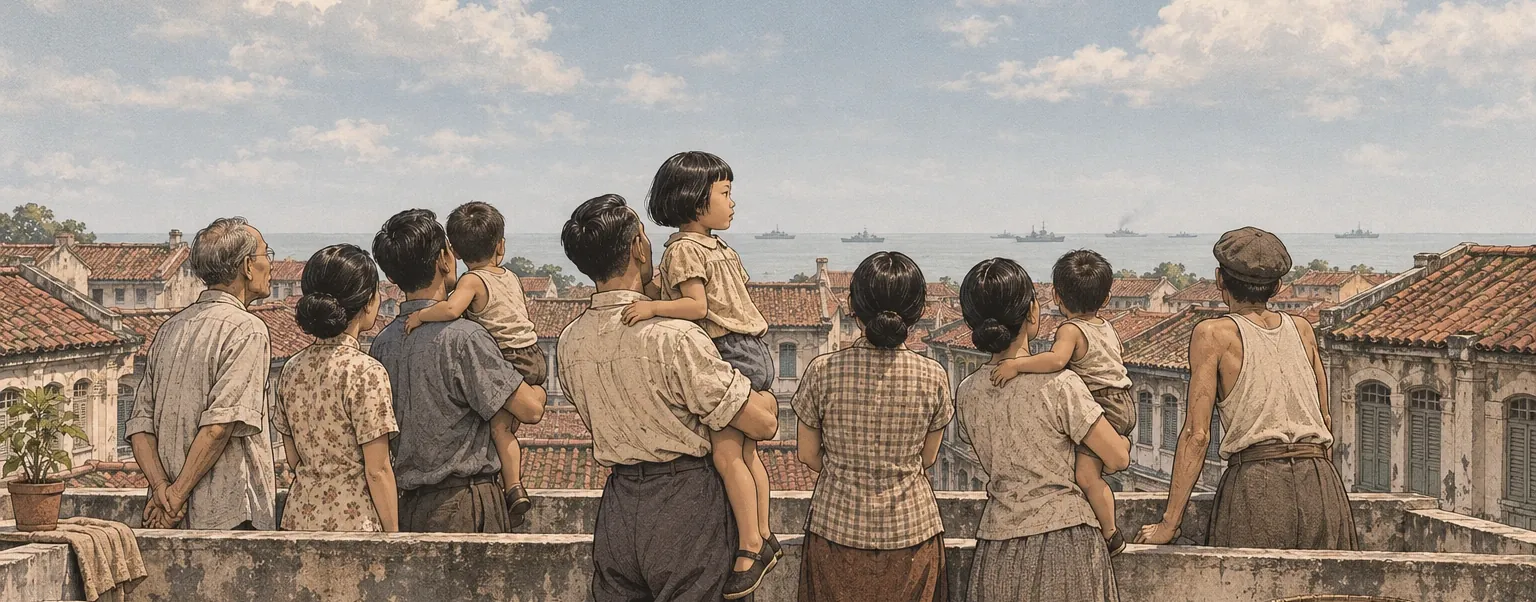
On a rooftop a group of neighbours hold small children up to look out to sea; one man holds Mei Lin, a five-year-old girl with a short bob and a straight fringe, high on his arm; far off on the hazy horizon are small grey shapes of ships; everyone is quiet.
IN THOSE UNEASY WEEKS THE STREET HELD TOGETHER.NEIGHBOURS KEPT WATCH IN TURN AT THE HEAD OF THE LANE,TO SEE WHO CAME.THEY SHARED WHAT FOODTHERE WAS, A HANDFUL ATA TIME, DOOR TO DOOR.NOBODY HAD ASKED THEMTO.MEI LIN HAD A QUIET YEAR,AS FAR AS SHE COULD TELL.SHE LEARNED TO WRITE HEROWN NAME, WITH A STICK INTHE DUST.That stroke goes theother way.AFTERWARDS SHE DIDNOT REMEMBER ANY OFTHE GROWN-UPS'FEAR. SHEREMEMBERED THEBALL, MADE OF RAGS.SEPTEMBER 1945: WHEN THE BRITISH SHIPS CAME, SHE WASTAKEN UP ONTO THE NEXT ROOF WITH THE OTHER CHILDRENAND HELD UP TO SEE.SHE COULD NOT TELL WHICH WERE THE SHIPS.SHE SAID LATER THEY HAD BEEN VERY FARAWAY, AND THAT EVERYONE HAD BEEN VERYQUIET.
1945 · page 5
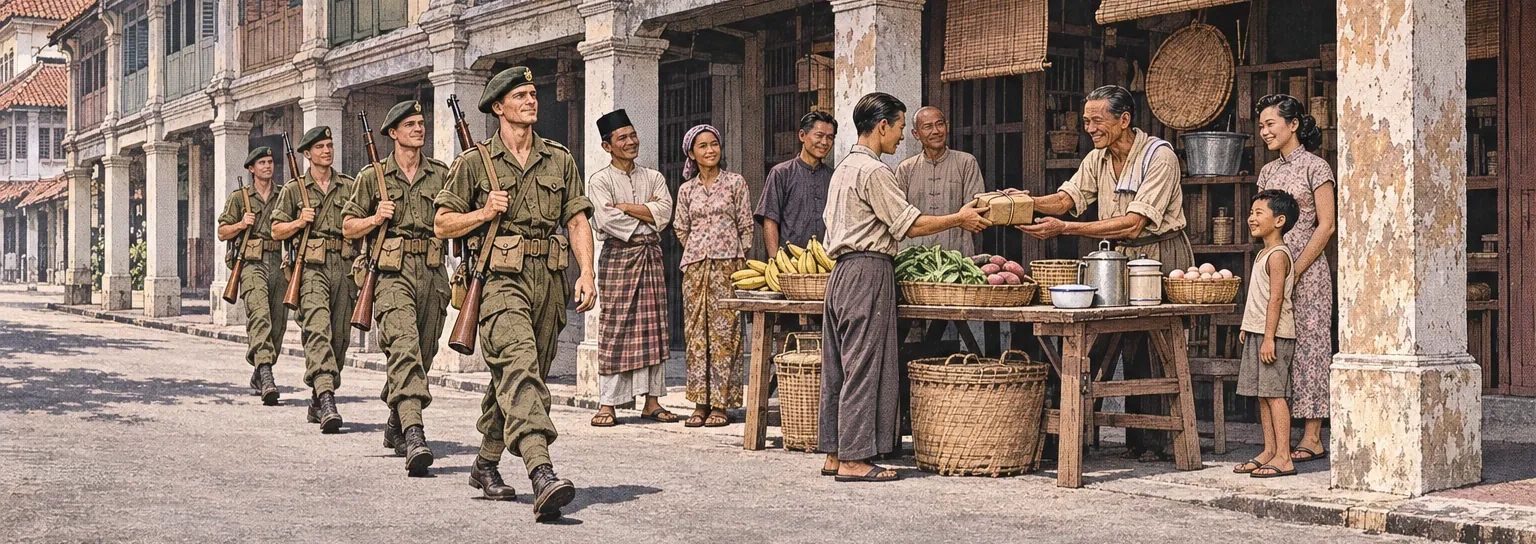
A short file of British soldiers in jungle-green uniforms with rifles slung walks down the middle of the shophouse road; residents watch from the five-foot ways, some cautiously smiling.
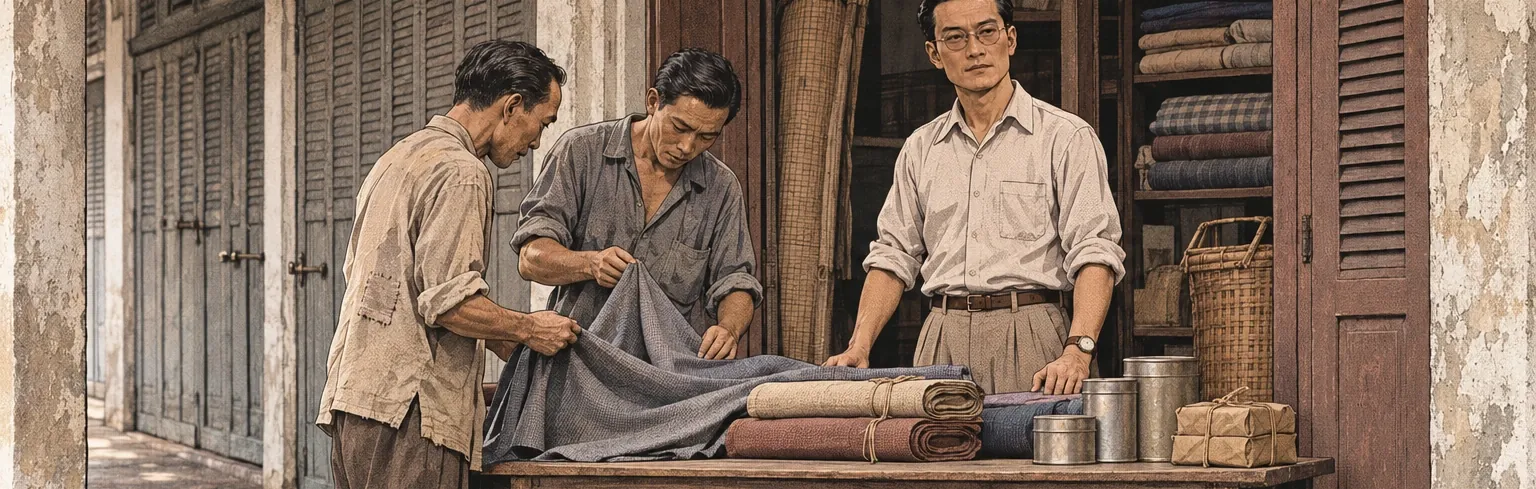
Cheng Huat, in a clean white shirt, stands behind a plain table set out in front of the shop with small lots of goods: a few bolts of cloth, tins, bundles; two customers already handle the cloth; the neighbouring shopfronts are still shuttered.
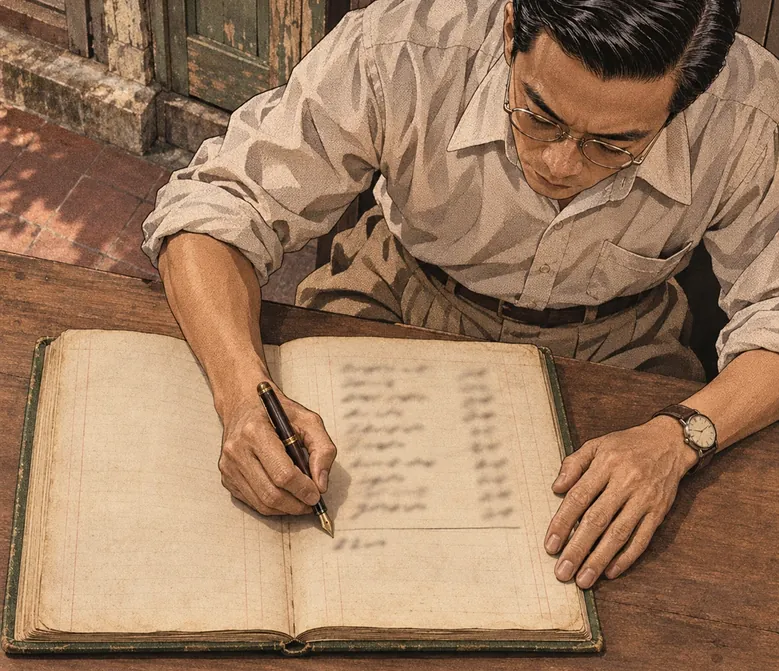
Looking down at a table: a large ledger with a green cloth cover lies open flat, its last page showing a column of handwritten figures with a ruled line beneath; a man's hand writes a new date (unreadable) under the line with a pen.
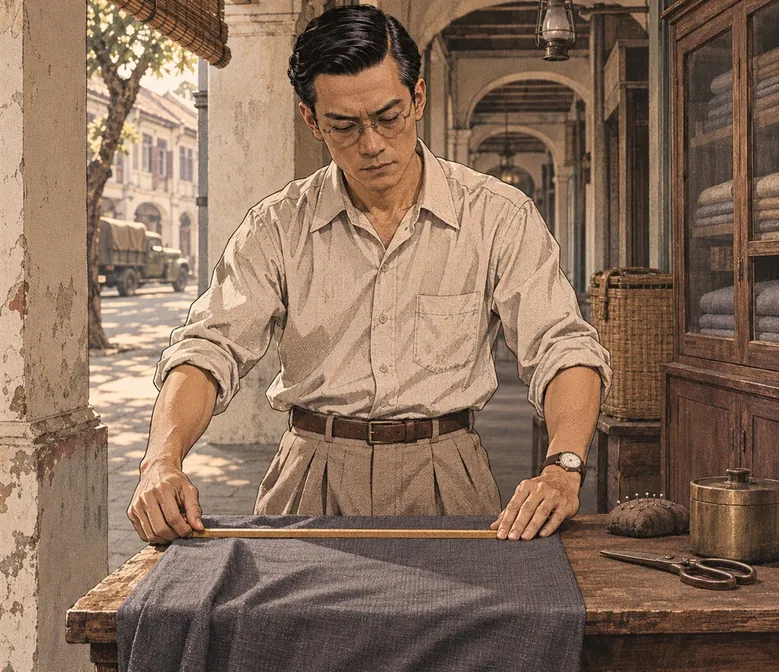
Cheng Huat, head down, measures cloth against the edge of his table, absorbed in the work; the street goes by behind him.
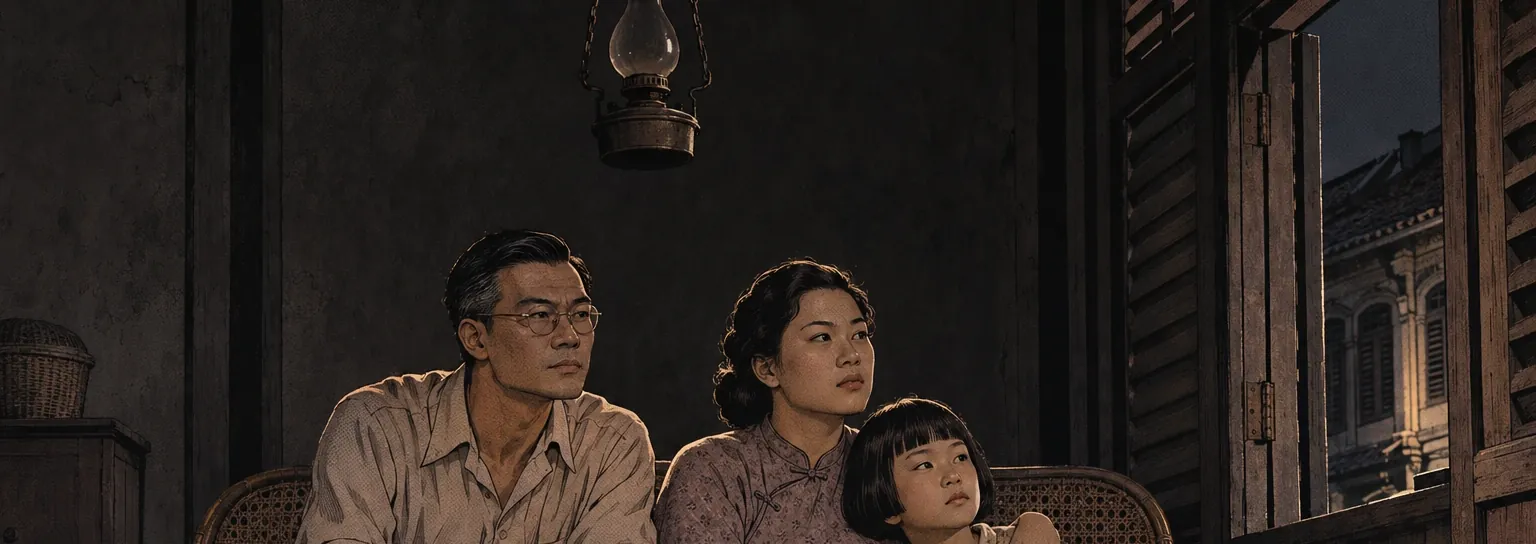
The family sits together in the dark front room, lit only by faint street light through the open shutters: Cheng Huat and Swee Neo side by side on the cane settee, Mei Lin, a five-year-old girl with a short bob and a straight fringe, leaning against her mother; the unlit oil lamp hangs above them; all three are listening to the street outside.
THE FIRST BRITISH SOLDIERSWALKED DOWN THE ROAD INSEPTEMBER.TAN CHENG HUAT, 37, DIDNOT BELIEVE INBEGINNINGS. IN HISEXPERIENCE A GOOD MONTHWAS FOLLOWED BY A BADONE.BUT A DAY AFTER THESOLDIERS CAME HE WASAMONG THE FIRST IN THEDISTRICT TO PUT A TABLEOUT AND SELL SOMETHINGACROSS IT.THE GREEN LEDGER HAD SATAT THE BOTTOM OF A TRUNKSINCE THE LORRY CAME TOTHE GODOWN IN 1942.HE OPENED IT TO THELAST PAGE, THE DATEAND THE LINE UNDERTHE EMPTY COLUMN,AND WROTE THE NEXTDATE UNDER IT.FOR THE REST OF THEYEAR HE KEPT HISHEAD DOWN ANDWORKED. NOBODY CAMETO THE DOOR ABOUTTHE SCARCE GOODS.HE DID NOT ASKHIMSELF WHY. HE WASCAREFUL NOT TO.THE SHOPS WERE NOT FULL, AND THE MONEYWAS NOT WHAT IT HAD BEEN.THAT NIGHT, FOR THEFIRST TIME IN THREE ANDA HALF YEARS, HE LEFTTHE LAMP UNLIT. THEY SATIN THE DARK AND HEARDTHE STREET GO BY.
The year in money. Household income about $815 a month, against a peer median of $120: 6.8 times the median (nominal dollars; a model estimate).
The real 1945

In early 1945 Syonan-to is at its hungriest: rations are minimal, prices are extreme, and Allied bombers raid the harbour and naval base. Japan announced its surrender on 15 August 1945; the British Military Administration took over after the formal surrender ceremony on 12 September (British forces landed from 5 September).

More on Singapore in 1945 ▸

Behind the dice How likely was each thing that happened? (Spoilers)

Nothing in The Dice Decides is chosen by a writer. Each person's year is a set of rolls, weighted by their stats and their times; the story is written afterwards to fit what the dice decided.

WhoWhat the dice decidedResultChance
Lim Swee NeoSoldiers search the house; one shoves Swee Neo against the wall.soldiers6%
Tan Cheng HuatAmong the first in the district to trade again once the British return; the green ledger comes out.yes44%
Lim Swee NeoAfter the search her hands are not steady and the sewing custom falls away.no60%
Tan Mei LinIn the uneasy weeks the street keeps watch and shares food door to door.neighbours close ranks11%
Tan Mei LinA quiet year for the child: her name in the dust and a ball of rags.quiet35%
Tan Cheng HuatA quiet year: head down, working.quiet29%
Tan Mei LinNo serious illness for Mei Lin.no98%
Tan Mei LinThe surrender does not wipe out the family's savings in banana notes.no58%
Tan Mei LinMei Lin alive at the year's end.no99%
Tan Cheng HuatCheng Huat is not seriously ill.no95%
Tan Cheng HuatCheng Huat survives the year.noover 99%
Lim Swee NeoSwee Neo is not seriously ill.no93%
Lim Swee NeoSwee Neo alive at the year's end.noover 99%
Tan Cheng HuatNeither the last months nor the interregnum catch the household; nobody comes about the scarce goods.none79%

Chances are the simulation's model assumptions, not historical statistics.

Household income as a multiple of the peer median, 1941–1945
0×4×8×12×peer median1945
Show as a table
YearHousehold a monthPeer medianMultiple
1941$504$4212.0×
1942$82$422.0×
1943$148$423.5×
1944$204$424.9×
1945$815$1206.8×

Nominal dollars; the engine's model estimate, the same figure as each issue's money line.

The chapter in prose

1945: The Quiet After

In 1945 the Japanese Occupation ends. Early in the year soldiers search the Tan house and frighten Lim Swee Neo, who is already weakened by hunger, and her sewing falls off. When Japan surrenders in August, the street comes together, and when the British return Tan Cheng Huat is among the first to trade again. Five-year-old Mei Lin has a quiet year, and all three of them are alive when it ends.

The Search

They came to the house in the early part of the year, at an hour when nobody expected anyone. Four of them, and a man who translated. They did not say what they were looking for. They went through the rooms one at a time, with the doors open, turning out the cupboards and lifting the mats, and they did not break anything that was not in the way.

Swee Neo stood in the front room with her hand on the back of a chair, because she had stopped trusting her knees. One of them, a young man who might have been twenty, came back from the kitchen, looked at her for a while, and pushed her aside with his forearm, hard enough that she hit the wall. The translator said a sentence in Malay. She did not understand the words. She understood him.

Mei Lin watched from the door of the back room, with the tin lid in both hands. Nobody looked at her. When they had gone, Swee Neo went on standing where she was for a good while. Then she went to the kitchen, and put the cupboards back, and washed the cups that had been moved.

She sewed less after that. The women came with their hems and she took them, and then kept them a week past the day she had promised. Her hands were not steady, and she knew it, and so did they. It was a long time before the custom came back.

The Fifteenth of August

The news of the surrender came into the street through the neighbours, as news had been coming for nearly four years, by someone calling it softly across a wall. Japan had agreed to the Allies' terms. It was a radio that did it, in a back room with the curtains drawn, and a man who had never owned one before the war, and had hidden it in a barrel.

Some of the street wept. Some laughed. Most of them did what they had done for years: waited to see what would happen next. The British ships did not come into the harbour until September, and the weeks in between were uneasy ones, in which nobody was sure who the street now answered to.

In the Tan house nobody said very much. Cheng Huat sat down on the back step, as he had done after the screening centre, and Swee Neo sat down beside him, which she had not done in years.

The Street Close Ranks

What the street did, in the end, was hold together. The neighbours kept a watch in turn at the head of the lane in the uneasy weeks, to see who came; they shared out what food there was, a handful at a time, door to door. Nobody had asked them to. They did it because they had been doing it for a year.

Mei Lin had a quiet year, as far as she could tell. She was five. She learned to write her own name, in Chinese, with a stick on the dust of the back yard, and her mother stood at the door and corrected her. She played with the children from the next house, who had a ball made of rags. She did not remember, afterwards, any of the grown-ups' fear. She remembered the ball.

When the British ships came she was taken up onto the roof of the next house with the other children and held, so that she could see. She could not tell which ones were the ships, among the grey shapes on the horizon. She said later that they had been very far away, and that everyone had been very quiet.

First to Open

Cheng Huat did not believe in beginnings. He had learned over four years that a good month was usually followed by a bad one, and he was careful to say so when anyone in the family looked pleased. But that year he was among the first in the district to put a table out in front of the shop and sell something across it, a day after the first British soldiers had walked down the road.

It was not much: what he had saved, what he could get from the first ships, in lots small enough to carry. He wrote each lot down. The ledger with the green cloth cover, which had sat at the bottom of a trunk since the lorry came to the godown in 1942, came out and was set on the table. He opened it to the last page, which had the date and the line beneath the empty column, and wrote the next date under it.

For the rest of the year he kept his head down and worked. Nobody came to the door about the other business, the scarce goods, and he did not ask himself why. He was careful not to.

The shops were not full, and the money was not what it had been, but that night for the first time in three and a half years Cheng Huat left the lamp unlit in the front room, and the family sat in the dark and heard the street go by outside.