The Merchant's Daughter

Issue #5 · 1944: What the Street Shared

1944

In 1944, the Tan family's fourth year of war, the street holds together. Neighbours share what they have and warn one another of what they hear, and an older neighbour is kind to four-year-old Mei Lin. Tan Cheng Huat's small trading holds up, and he and Lim Swee Neo grow closer in the evenings. Swee Neo's sewing and cooking bring in more custom, but she eats last and hunger leaves her weaker. Nobody in the house dies or falls seriously ill, and the military police pass the door.

A work of fiction set in real history. The characters are invented; the historical events are real and sourced.

Previously, in 1943…

In 1943, the third year of the war for the Tan family and the second under Japanese rule in Syonan-to, Tan Cheng Huat finds a way to earn again without a firm. He buys and sells small goods, and takes a careful share in a scarce-goods trade he would once have refused. Lim Swee Neo sews and sells at home, and gets worrying news of a relative. Fever and hunger-sickness run through the neighbourhood and the household is spared. Their three-year-old daughter, Mei Lin, has a quiet year.
1944
What the Street Shared
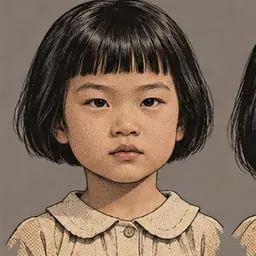
Tan Mei Lin, 4
the child of the house
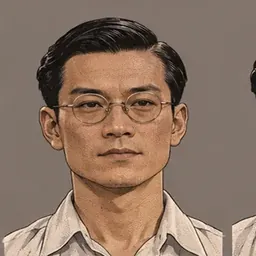
Tan Cheng Huat, 36
her father, a merchant trading in small goods
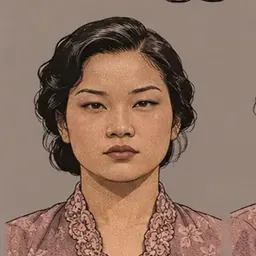
Lim Swee Neo, 29
her mother
1944 · page 1
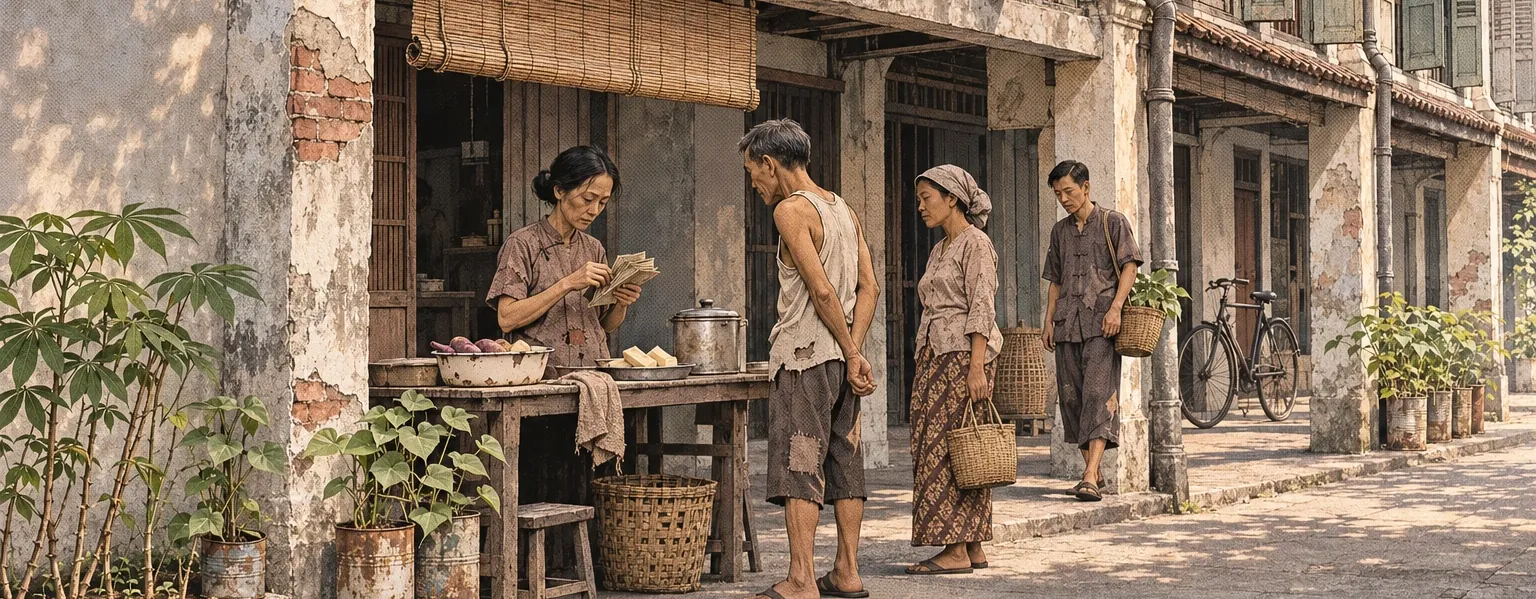
A hungry shophouse street in the fourth year of the war: tapioca and sweet potato plants grow in every spare strip of ground and in old tins along the five-foot way; thin residents go about their business; a woman counts a thick wad of creased occupation banknotes at a nearly bare stall.
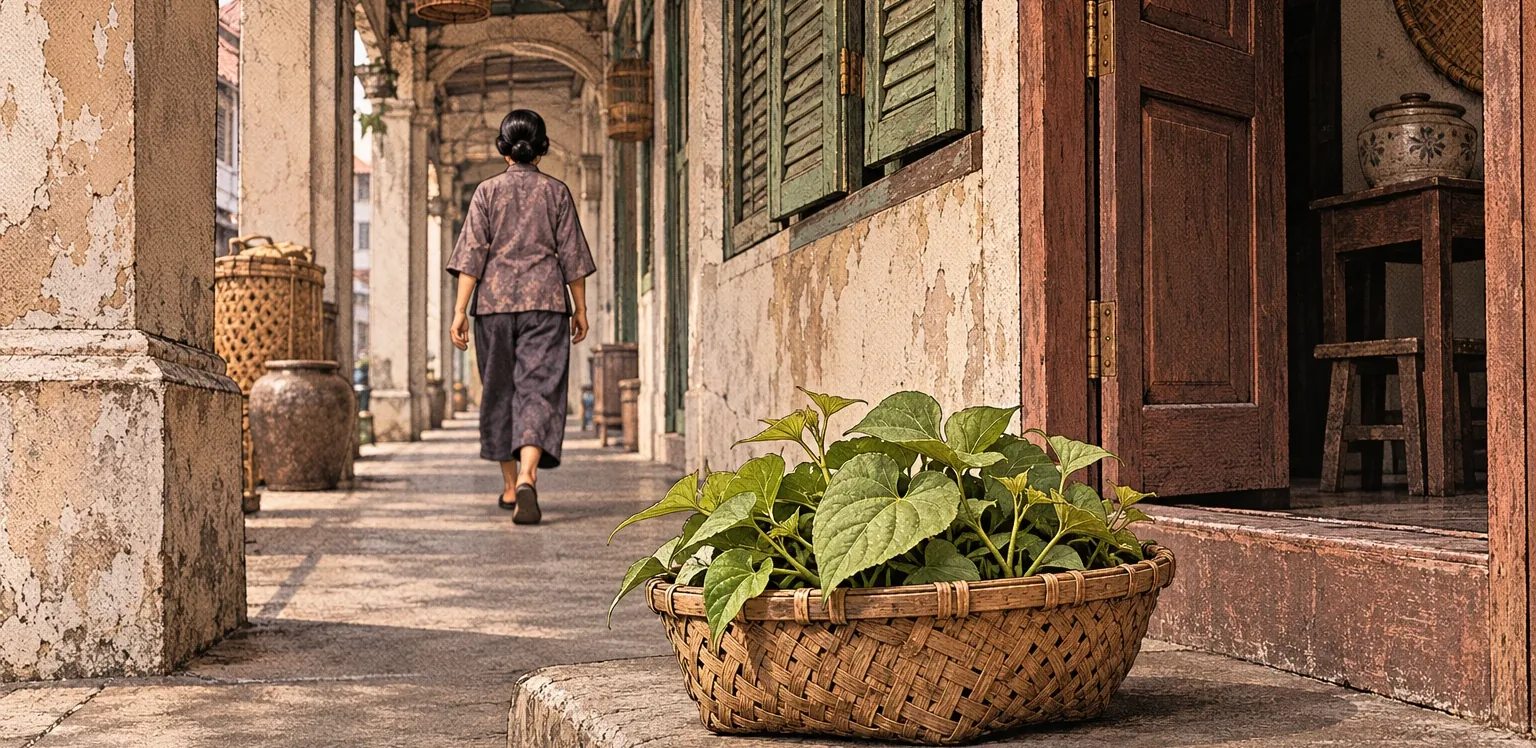
On the front step of a shophouse sits a small woven basket of fresh sweet potato leaves; a neighbour woman, seen from behind, is already walking away along the five-foot way without looking back.
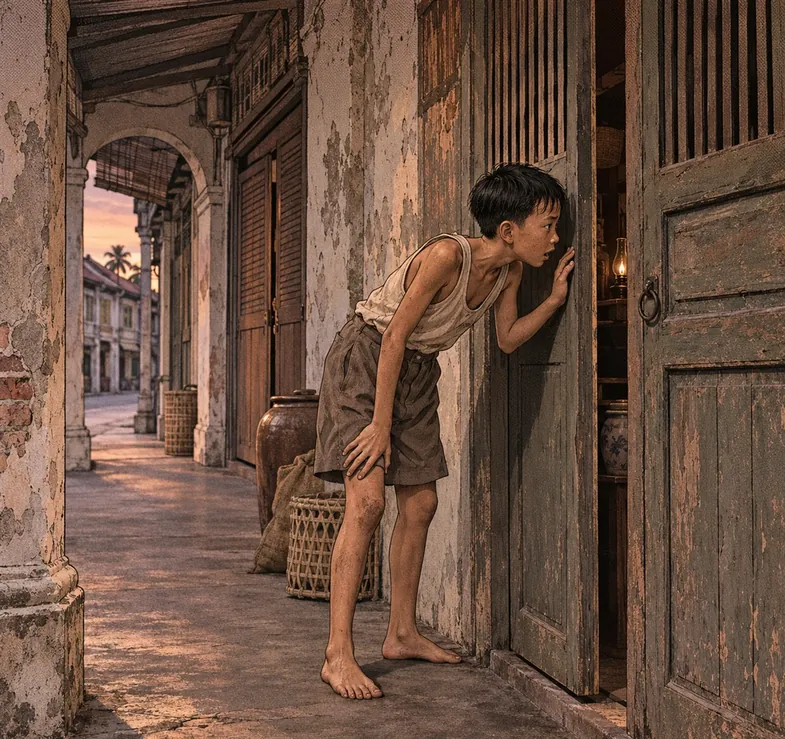
A barefoot boy of about ten, out of breath, leans in at a half-open shophouse door and speaks low to someone inside; further down the five-foot way another door is already closing.
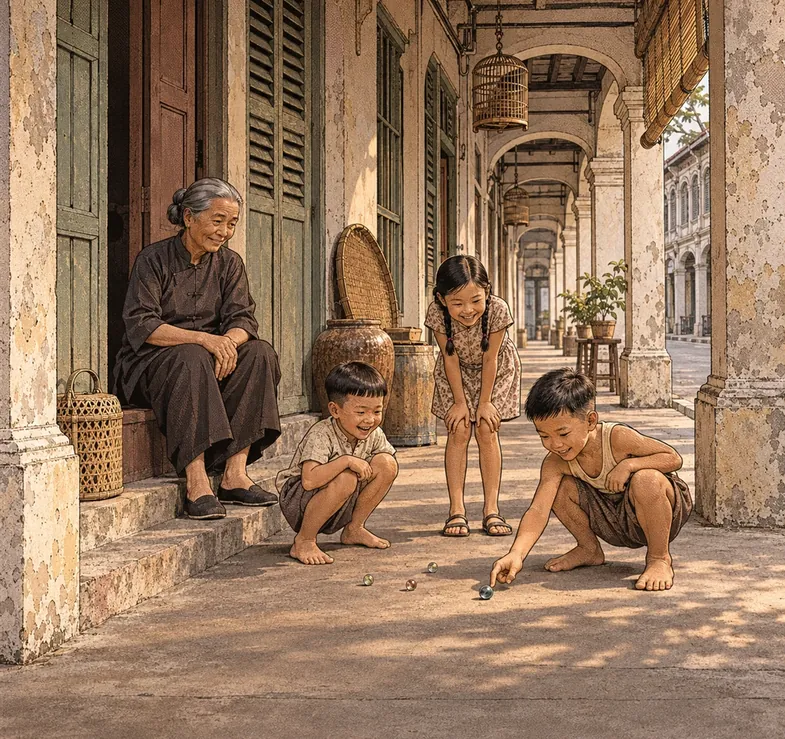
An older Chinese woman with grey hair in a bun sits on her front step in the good late-afternoon light, hands in her lap, watching two or three small children play in the five-foot way.
1944: THE FOURTH YEAR OF THE WAR FOR THE TAN FAMILY.SYONAN-TO WAS HUNGRIER THAN A YEAR BEFORE.RICE WAS SCARCE; TAPIOCA AND SWEET POTATO WERE THESTAPLES. THE OCCUPATION MONEY BOUGHT LESS EVERY MONTH.BY THE FOURTH YEAR OF IT, THE STREET HAD BECOME A KINDOF HOUSEHOLD.A NEIGHBOUR LEFT ABASKET OF SWEET POTATOLEAVES ON THE STEP, WITHNO EXPLANATION.AT DUSK A BOY RAN FROM DOOR TO DOOR, TO SAYWHICH ROAD THE PATROL WAS ON THAT NIGHT.The patrol's on theother road tonight.A WOMAN TWO HOUSES DOWN, WHOSE OWN CHILDRENWERE GROWN AND GONE, SAT ON HER FRONT STEPWHEN THE LIGHT WAS GOOD.SHE WATCHED THE LITTLEONES.
1944 · page 2
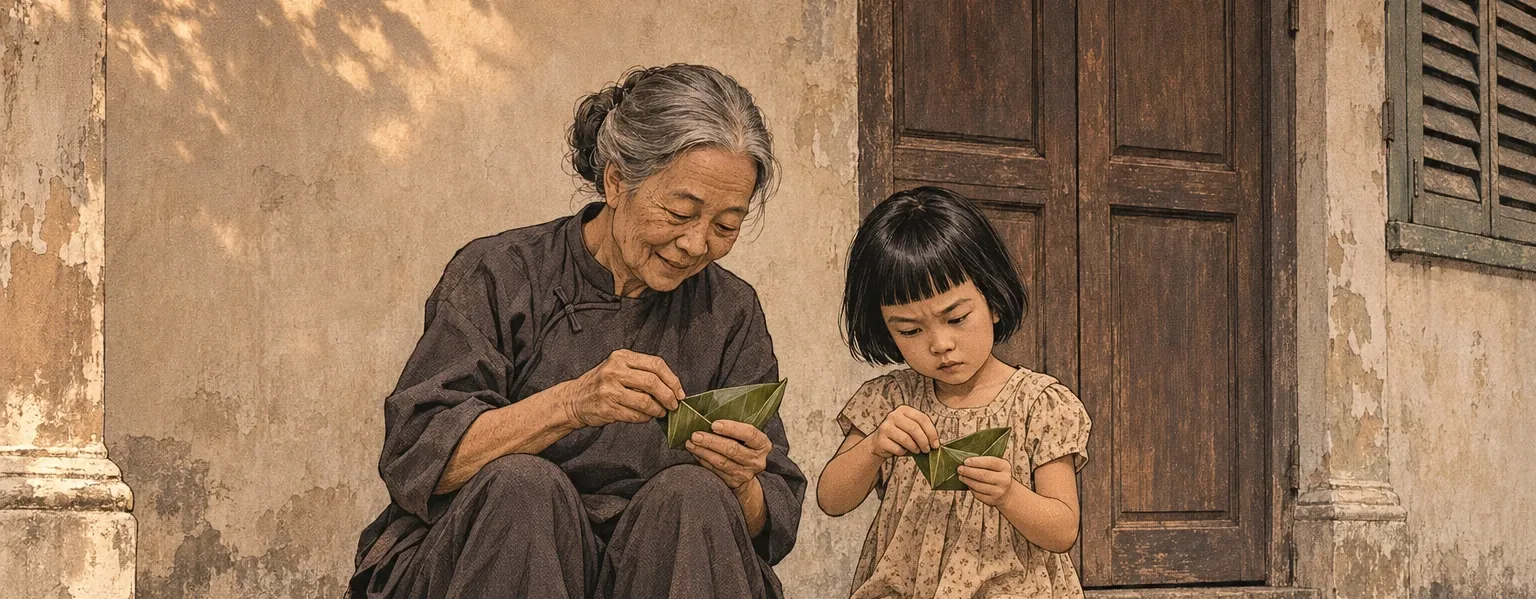
On her front step the older neighbour woman sits folding a piece of banana leaf into a little boat; beside her Mei Lin, a four-year-old girl in a simple cotton dress with a short bob and a straight fringe, kneels close and copies her with her own piece of leaf, frowning in concentration.
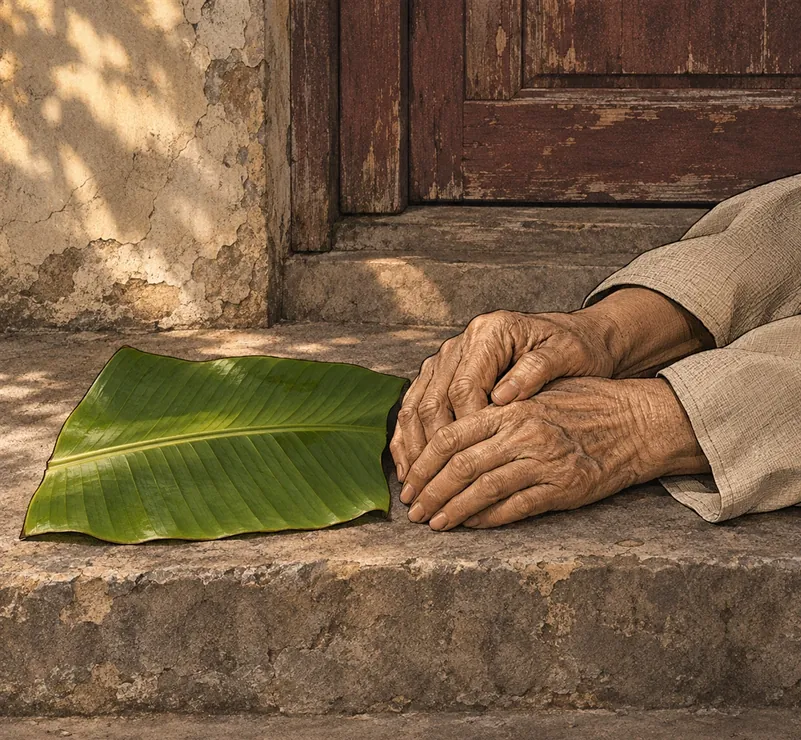
A fresh green banana leaf lies ready on the worn stone step beside the older woman's folded hands, waiting.
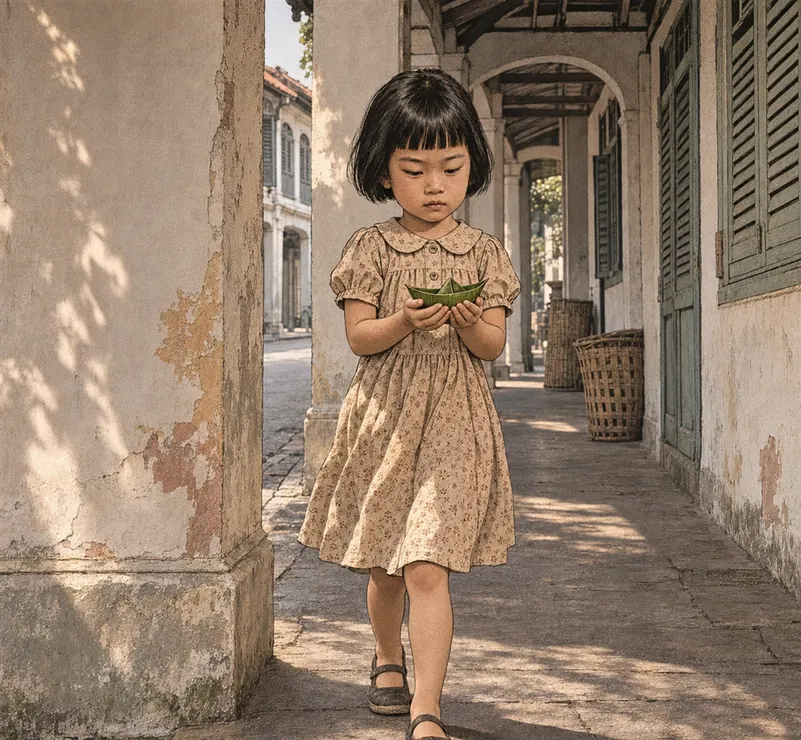
Mei Lin, a four-year-old girl in a simple cotton dress with a short bob and a straight fringe, walks home very carefully along the five-foot way carrying a small folded banana-leaf boat in both cupped hands, eyes fixed on it.
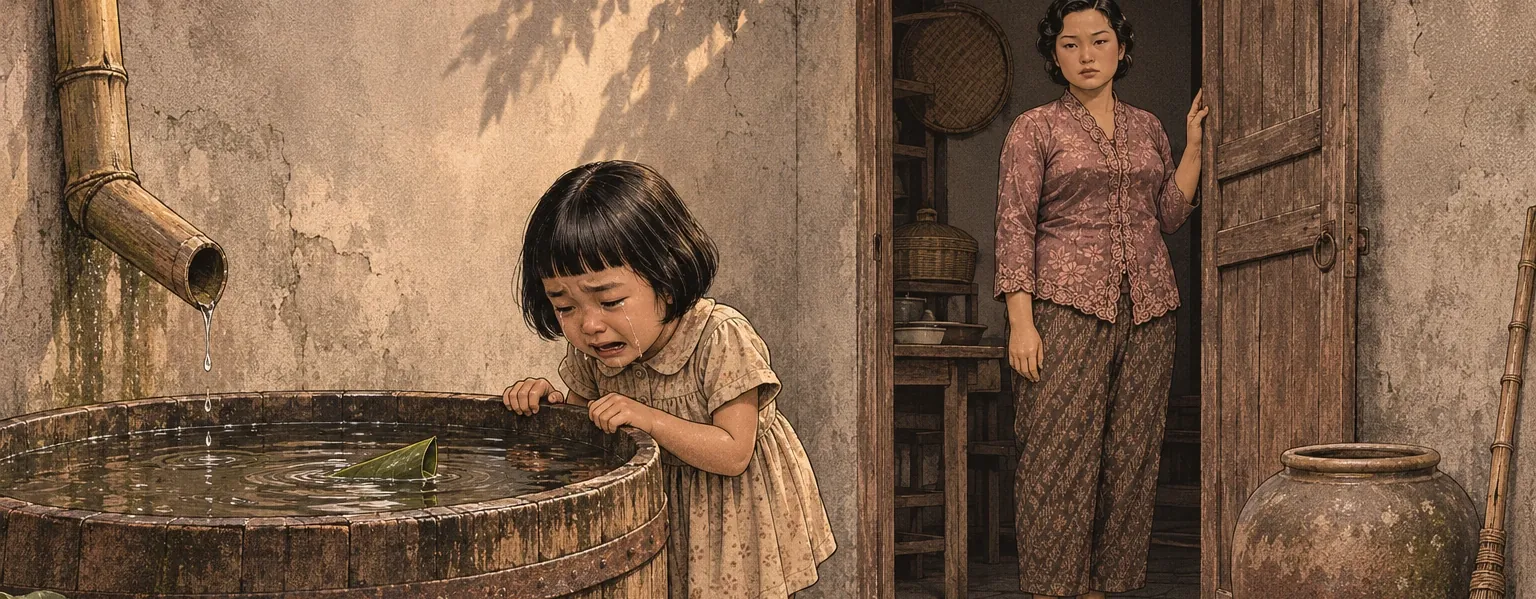
At the rain barrel Mei Lin, a four-year-old girl in a simple cotton dress with a short bob and a straight fringe, stands on tiptoe crying, looking at a little banana-leaf boat half sunk in the water; Swee Neo stands in the back doorway with a hand on the frame, watching her.
SHE WAS THE ONE WHO WAS KIND TO MEI LIN,4. NOBODY HAD ASKED HER TO BE.Fold it here. Now the otherside.THE NEXT AFTERNOON, WITHOUT A WORD ABOUT IT,THERE WAS ANOTHER LEAF.SHE HAD NOTHING TOGIVE THE CHILD TOEAT. SHE GAVE HERTHE AFTERNOON, ANDHER NAME, AND THEBOAT.MEI LIN CARRIED THEBOAT HOME IN BOTHHANDS.SHE FLOATED IT IN THE RAIN BARREL, AND IT SANK. SHECRIED FOR A MINUTE.Can I go back for another?
1944 · page 3
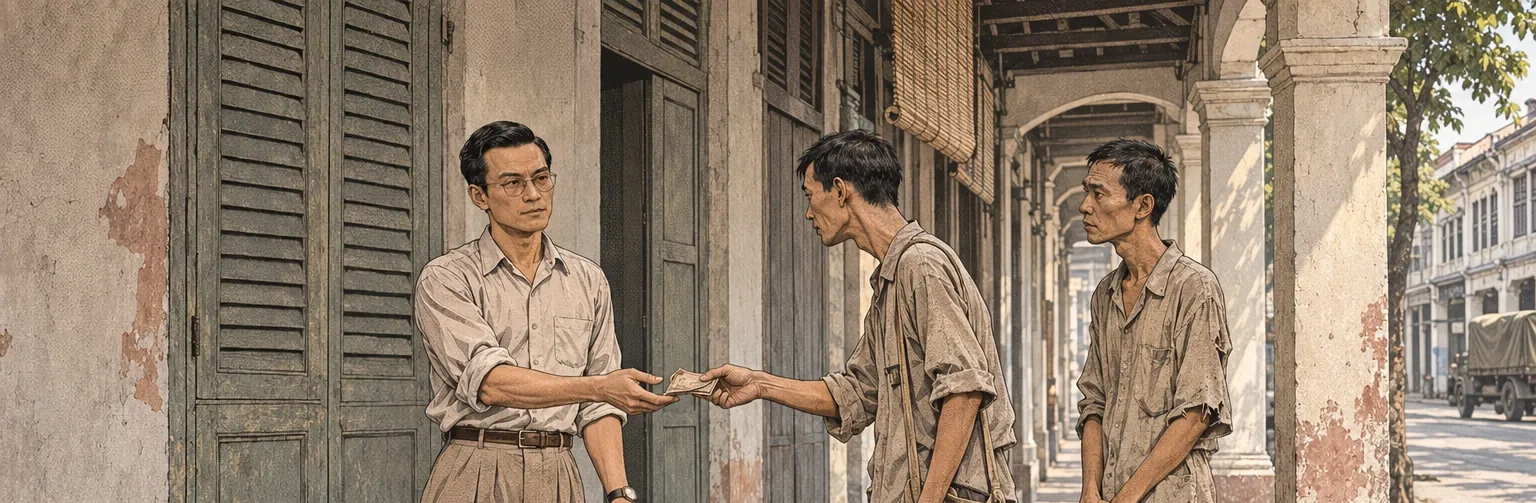
Cheng Huat, in a worn white cotton shirt, stands behind his small folding stall table of matchboxes, soap and thread while a customer hands him a fold of creased occupation banknotes; another man waits his turn.
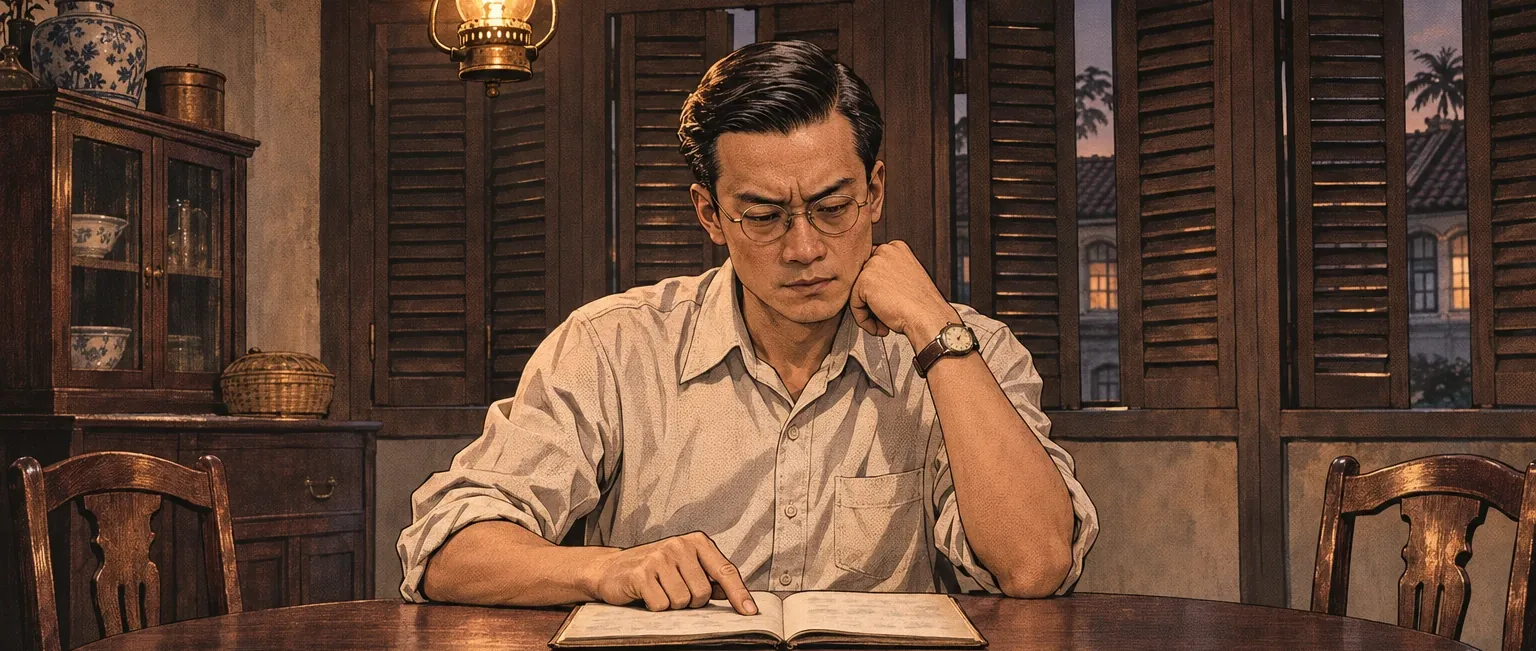
Cheng Huat sits at the round table with a slim pocket notebook lying open flat on the tabletop in front of him, one finger resting on a line of figures, reading it over through his spectacles, lips pressed together.
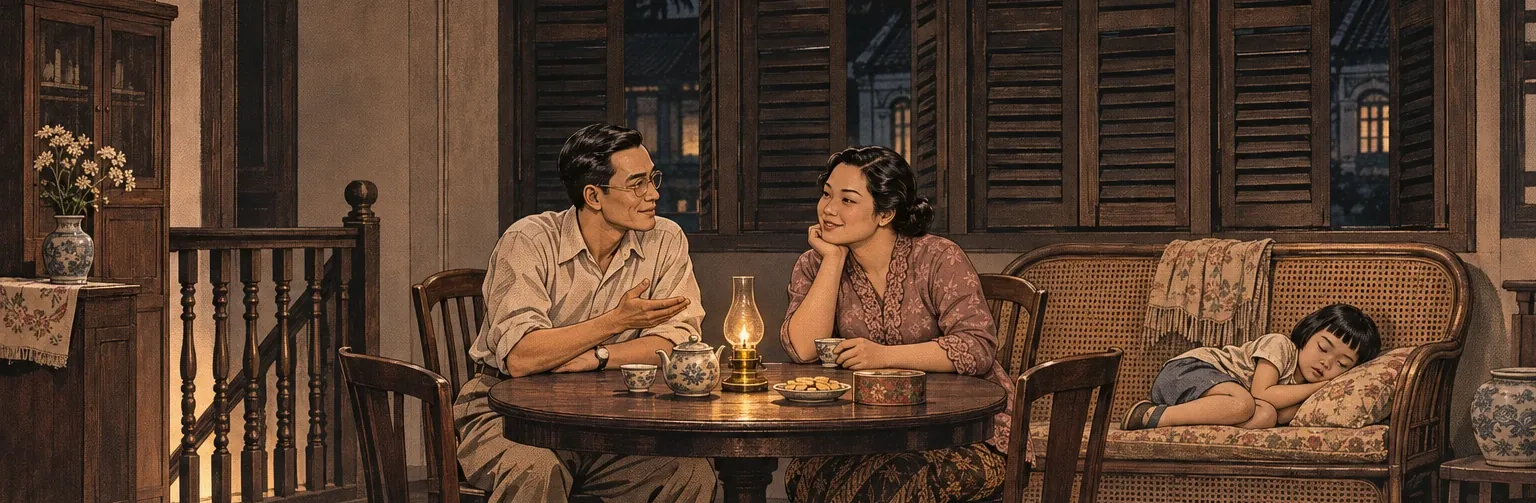
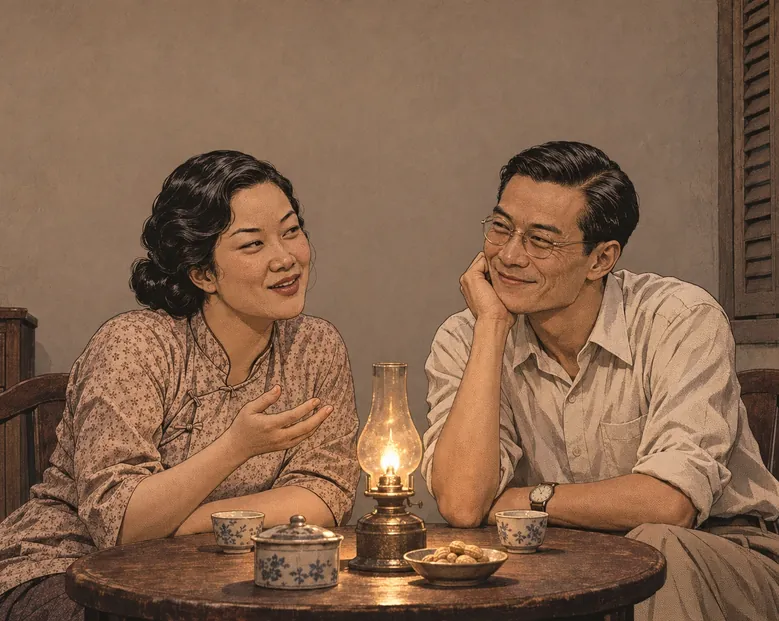
Cheng Huat and Swee Neo sit close together at the round table under the low lamp, turned toward each other, talking easily; behind them Mei Lin, a four-year-old girl with a short bob and a straight fringe, sleeps curled on the cane settee.
Close two-shot across the lamp: Swee Neo, smiling a little, tells Cheng Huat something; he laughs quietly, eyes creased behind his spectacles.
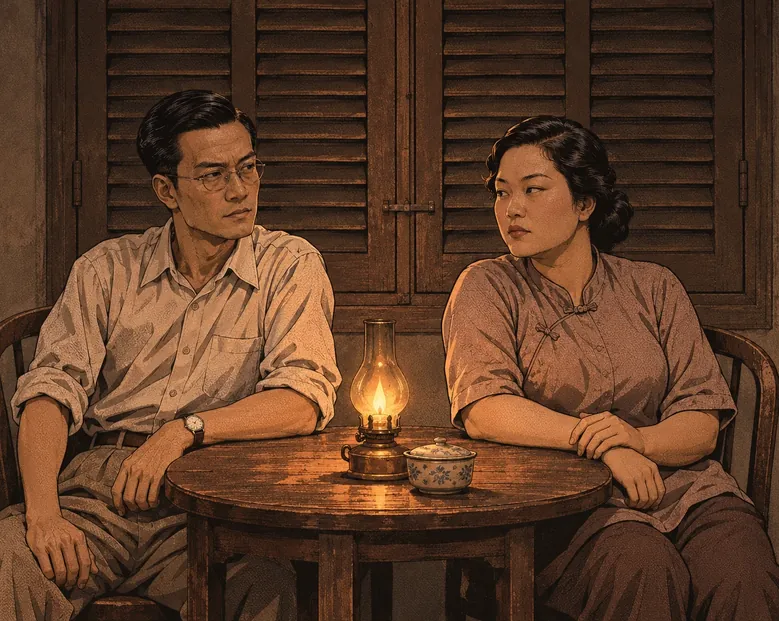
Cheng Huat and Swee Neo sit quiet for a moment at the table, the closed shutters behind them, both glancing toward the window as footsteps pass in the street below; then back to each other.
TAN CHENG HUAT, 36, FOUND THAT HIS TRADING HELD UPTHAT YEAR. HE DID NOT KNOW WHY, AND DID NOT TRUST IT.THE GOODS WERE THEREWHEN HE CAME FOR THEM.THE MEN HE SOLD TO PAID,MOSTLY ON TIME.HE WROTE IT ALL IN THENARROW BOOK, AND READTHE FIGURES OVER TWICEBEFORE HE BELIEVED THEM.WHAT HE NOTICED MORE, AFTERWARDS, WAS THE EVENINGS.THE WAR HAD MADE THEIR TALK CAREFUL, AND THEN SILENT.THIS YEAR, SOMEWHERE IN THEMIDDLE, IT STARTED TO COMEBACK.THEY SPOKE ABOUT SMALL THINGS. HE TOLD HERABOUT HIS DAY, AND SHE TOLD HIM ABOUT HERS.She's counting in threelanguages now. Allmixed up.And lamp oil's gone upagain.NEITHER OF THEM SPOKE ABOUT THE CURFEW, THEPATROLS, OR THE NIGHT HE HAD BEEN LATE.IT WAS AN AGREEMENTNOT TO, AND ITHELD. THE MILITARYPOLICE PASSED THEDOOR.
1944 · page 4
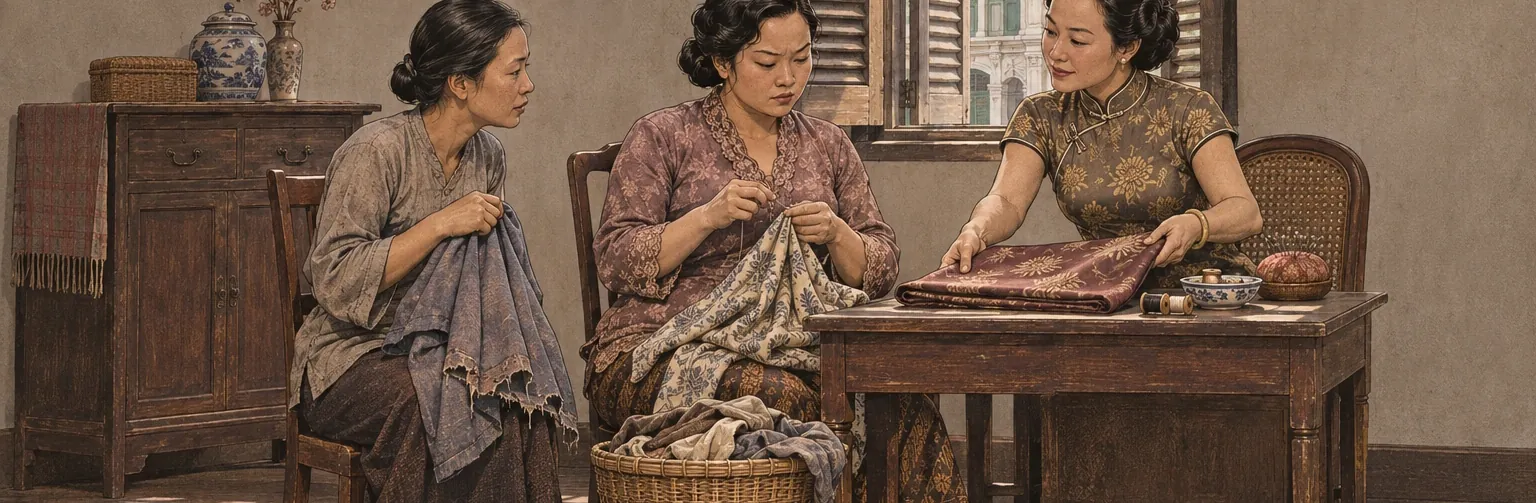
Swee Neo sits sewing by the window with a full basket of mending at her feet; one woman waits with a torn hem over her arm, and a better-dressed woman in a neat cheongsam lays a folded length of good cloth on the table for her.
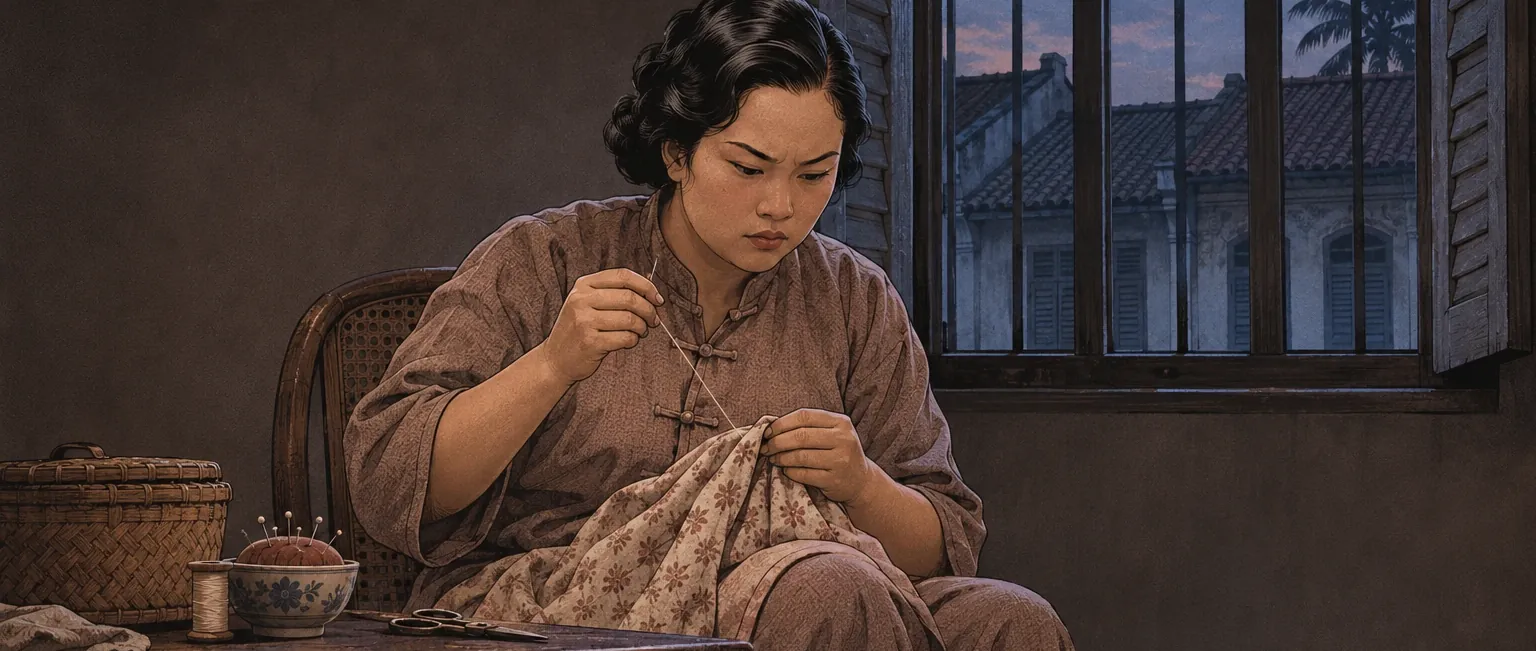
Swee Neo alone at the window in the last blue dusk light, leaning close to her sewing, needle raised.
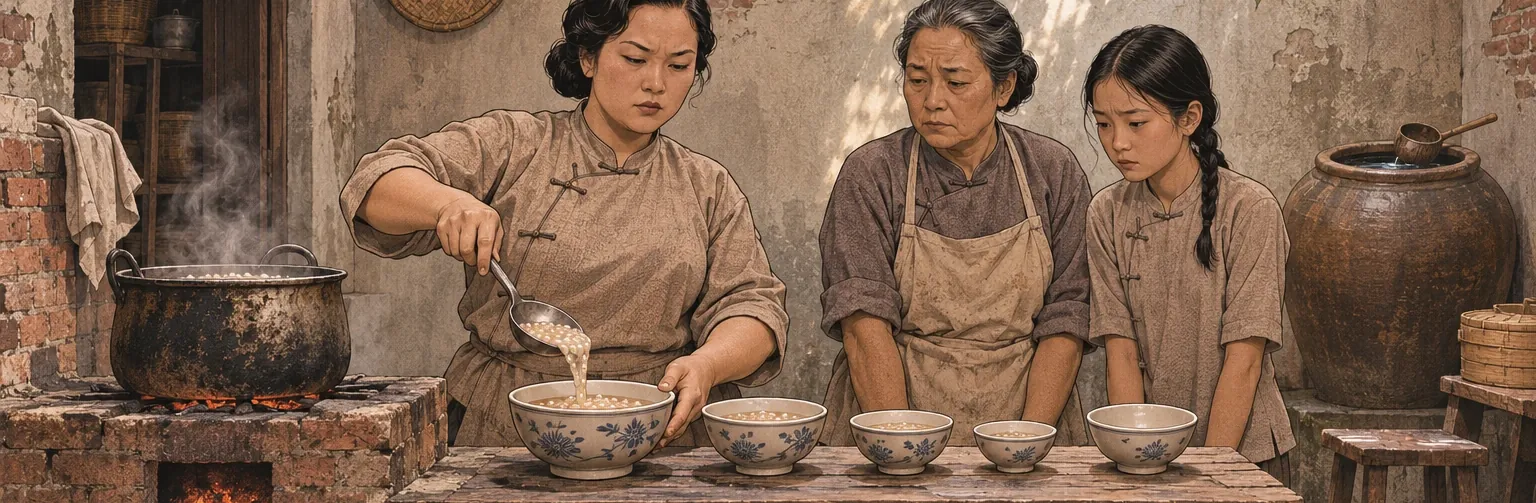
Swee Neo ladles tapioca from a pot into a row of four bowls of shrinking size on the bench; an older cook woman and a girl of about fourteen wait by the stove; Swee Neo's own empty bowl stands at the end of the row.
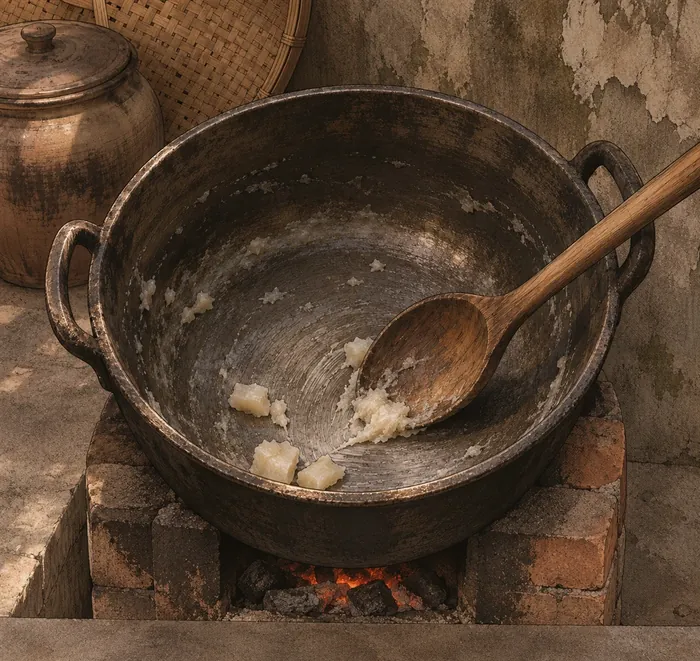
Close, looking down into a blackened cooking pot: a wooden ladle scrapes the last few pieces of tapioca from the bottom.
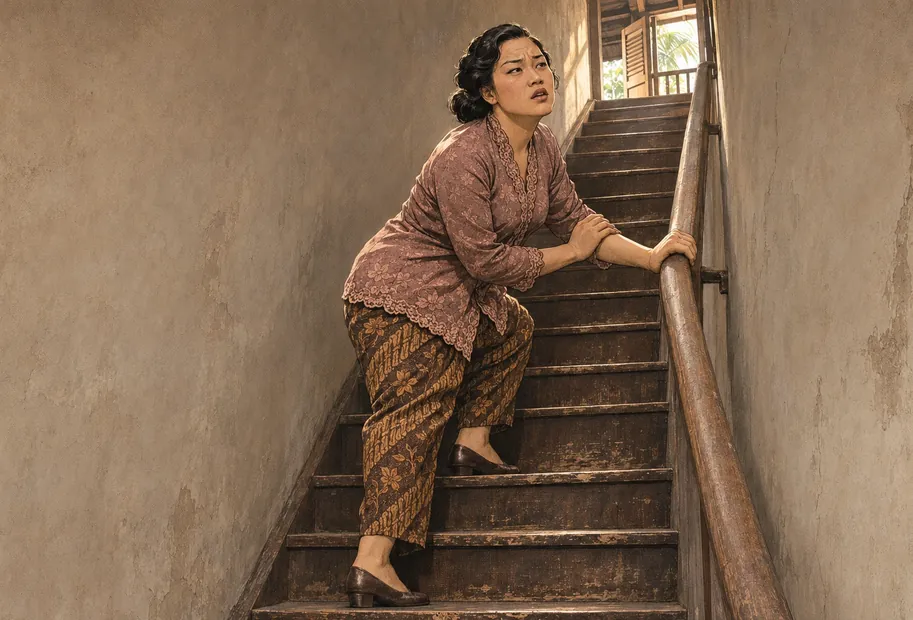
Swee Neo climbs the steep wooden stairs slowly, one hand on the rail, the other holding her wrist, pausing halfway to catch her breath.
LIM SWEE NEO, 29, HADMORE CUSTOM THAT YEAR:MORE WOMEN WITH SLEEVESAND HEMS.ONE, WHOSE HUSBAND HAD APOST OF SOME KIND WITHTHE NEW ADMINISTRATION,BROUGHT CLOTH TO BE MADEOVER.SHE WORKED AT THE WINDOWUNTIL THE LIGHT WENT,AND A GOOD WHILE AFTER.SHE FED THE HOUSEHOLD IN AN ORDER NOBODYHAD AGREED TO: THE CHILD FIRST, THENCHENG HUAT, WHO NEEDED HIS STRENGTH FORTHE WALKING.THEN THE COOK, AND THEGIRL WHO HELPED. SWEENEO ATE LAST, FROM WHATWAS IN THE POT.SOME DAYS THERE WAS LITTLE IN THE POT.SHE NOTICED IT INTHE AUTUMN. THESTAIRS TOOK LONGER.HER WRIST, AT THESEWING, BEGAN TOACHE.
1944 · page 5
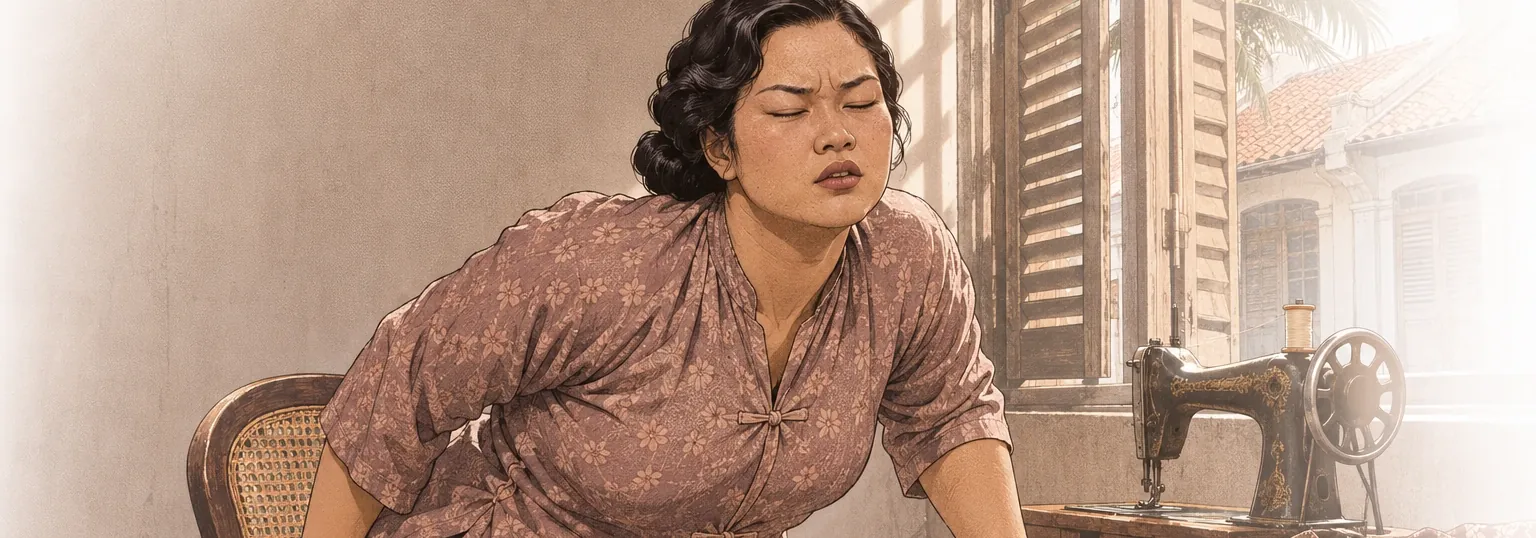
Swee Neo has half-risen from her chair by the sewing window, one hand braced flat on the table, eyes shut, swaying; the bright light at the edges of the picture washes out to white.
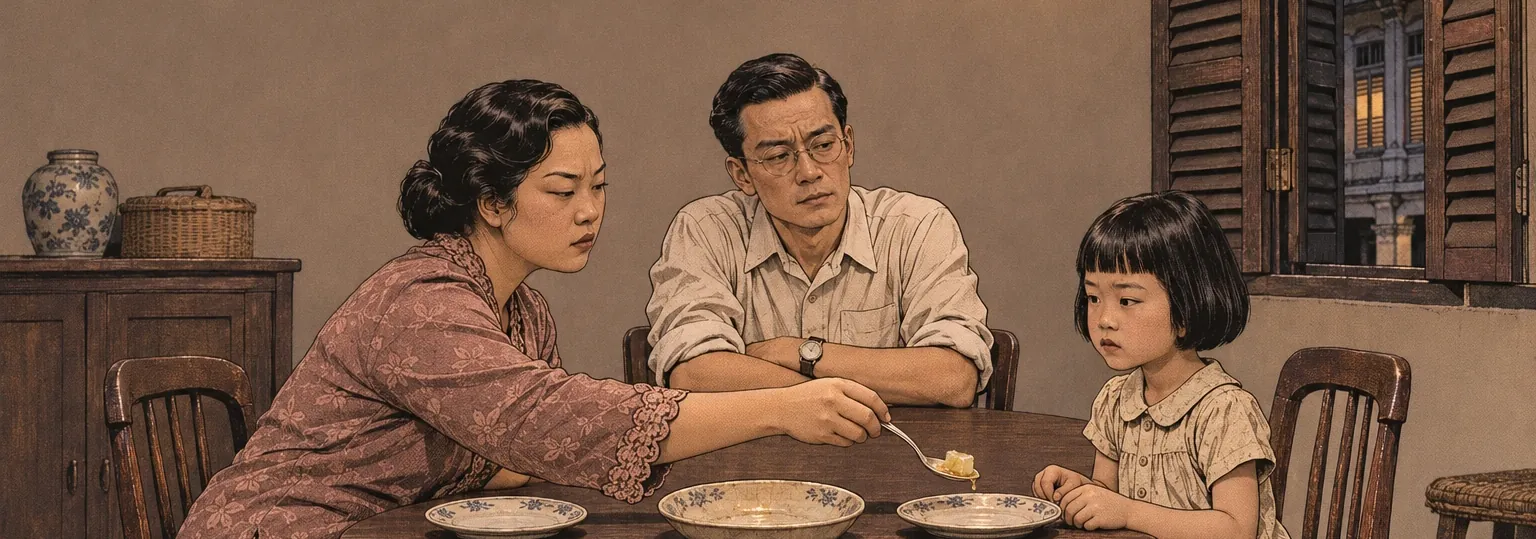
Supper at the round table: Swee Neo spoons the last piece of tapioca from a dish onto Mei Lin's plate, a four-year-old girl with a short bob and a straight fringe; Swee Neo's own plate is empty and clean; Cheng Huat, across the table, has stopped eating and is watching her.
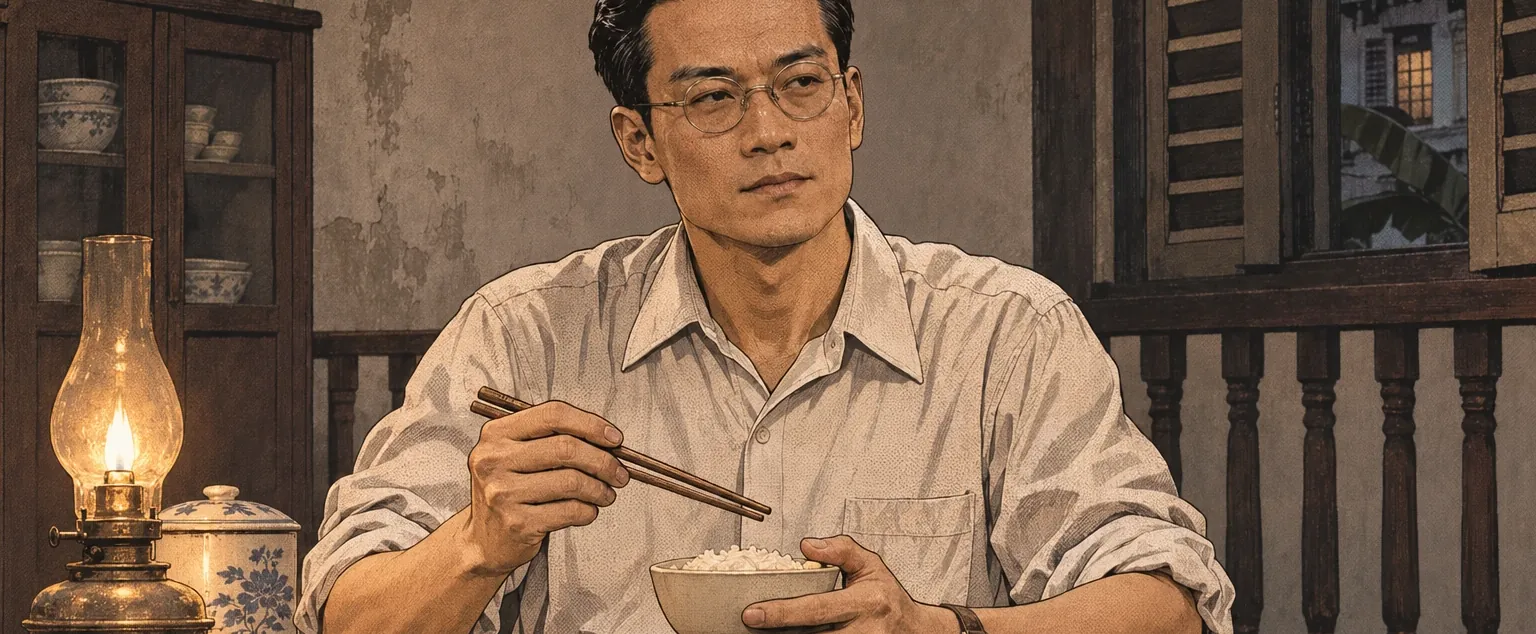
Cheng Huat at the table, chopsticks held still above his bowl, looking at his wife without a word, his face giving nothing away.
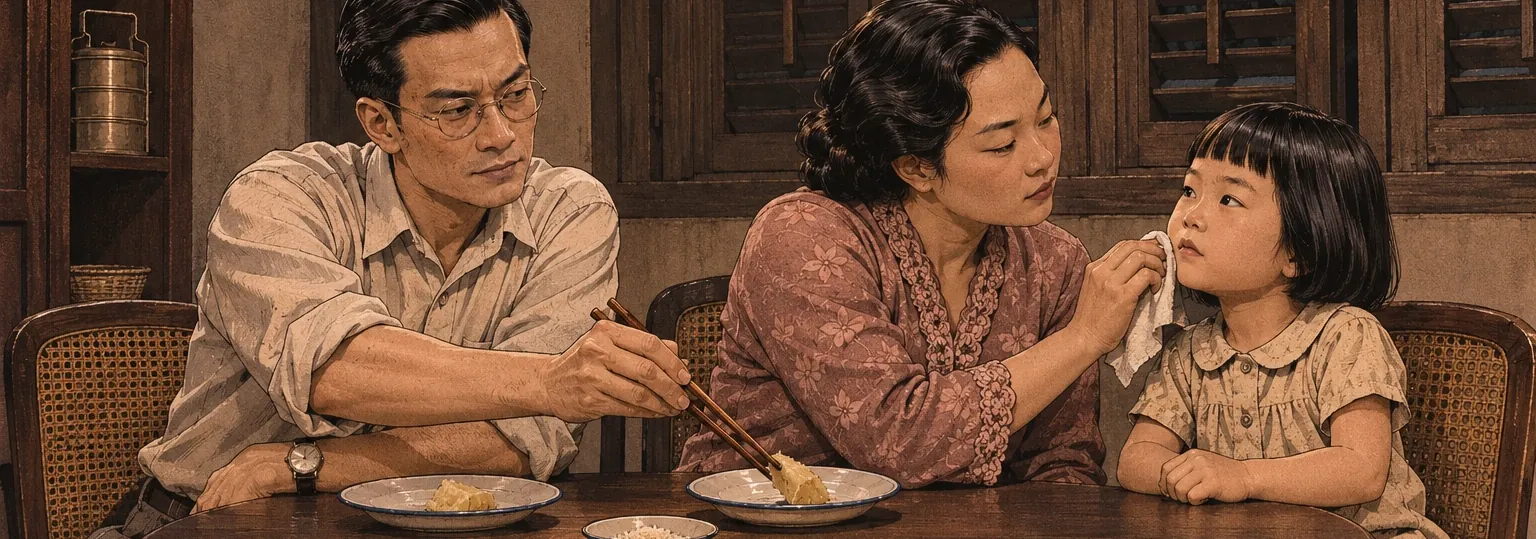
While Swee Neo has turned away to wipe Mei Lin's face, Cheng Huat quietly slides half of the tapioca from his own plate onto her empty plate with his chopsticks.
ONE AFTERNOON SHE STOODUP TOO QUICKLY, AND THEROOM WENT WHITE AT THEEDGES, AND CAME BACK.SHE SAT DOWN AGAIN ANDWENT ON, WITH HER HANDSWHERE THEY HAD BEEN. SHESAID NOTHING ABOUT IT.IN THE EVENINGS, AT THE TABLE,SHE WAS CAREFUL TO BE SEENEATING.Finish it. I ate in thekitchen.CHENG HUAT, WHO HAD BEEN IN THEKITCHEN, SAID NOTHING.LATER, WHEN SHE WASN'TLOOKING, HE PUT HALF OFHIS OWN ON HER PLATE.
The year in money. Household income about $204 a month, against a peer median of $42: 4.9 times the median (nominal dollars; a model estimate).
The real 1944

Syonan-to in 1944 is hungrier than a year before: rice is scarce, tapioca and sweet potato are the staples for most households, and the Japanese military 'banana' currency is inflating fast; prices rise month by month and by 1944 a wage buys a fraction of what it did.

More on Singapore in 1944 ▸

Behind the dice How likely was each thing that happened? (Spoilers)

Nothing in The Dice Decides is chosen by a writer. Each person's year is a set of rolls, weighted by their stats and their times; the story is written afterwards to fit what the dice decided.

WhoWhat the dice decidedResultChance
Lim Swee NeoEating last, she weakens: the stairs, the wrist, the room going white.hunger weakness6%
Tan Cheng HuatHis small trading holds up: the goods are there, and the buyers pay.yes49%
Lim Swee NeoMore custom for her sewing: sleeves, hems, and cloth to be made over.yes40%
Tan Mei LinAn older neighbour teaches Mei Lin to fold a banana-leaf boat.kindness9%
Tan Mei LinThe street shares food and warns of the patrols.neighbours close ranks11%
Tan Cheng HuatTalk comes back to the table in the evenings.closeness9%
Tan Mei LinNo serious illness for Mei Lin.no98%
Tan Mei LinThe money buys less, but nothing more has to be sold.no77%
Tan Mei LinMei Lin alive at the year's end.no96%
Tan Cheng HuatCheng Huat is not seriously ill.no95%
Tan Cheng HuatCheng Huat survives the year.noover 99%
Lim Swee NeoSwee Neo is not seriously ill.no93%
Lim Swee NeoSwee Neo alive at the year's end.noover 99%
Tan Cheng HuatThe scarce-goods trade is not found out; the military police pass the door.none75%

Chances are the simulation's model assumptions, not historical statistics.

Household income as a multiple of the peer median, 1941–1944
0×4×8×12×peer median1944
Show as a table
YearHousehold a monthPeer medianMultiple
1941$504$4212.0×
1942$82$422.0×
1943$148$423.5×
1944$204$424.9×

Nominal dollars; the engine's model estimate, the same figure as each issue's money line.

The chapter in prose

1944: What the Street Shared

In 1944, the Tan family's fourth year of war, the street holds together. Neighbours share what they have and warn one another of what they hear, and an older neighbour is kind to four-year-old Mei Lin. Tan Cheng Huat's small trading holds up, and he and Lim Swee Neo grow closer in the evenings. Swee Neo's sewing and cooking bring in more custom, but she eats last and hunger leaves her weaker. Nobody in the house dies or falls seriously ill, and the military police pass the door.

The Street

By the fourth year of it the street had become a kind of household. There was nothing grand in this. A neighbour left a basket of sweet potato leaves on the step with no explanation. A boy ran from door to door at dusk to say which road the patrol was on tonight. A woman two houses down, whose own children were grown and gone, had taken to sitting on her front step at the hour when the light was good, and watching the little ones.

She was the one who was kind to Mei Lin. Nobody had asked her to be. She called the child over one afternoon to show her how to fold a banana leaf into a boat, and the next afternoon, without a word about it, there was another leaf. She never gave her anything to eat, because she had nothing to give. She gave her the afternoon, and her name, and the boat.

Mei Lin carried the boat home in both hands. She floated it in the rain barrel, and it sank, and she cried for a minute and then asked to be taken back for another.

The Table After Dark

Cheng Huat's trading held up that year. He did not know why, and did not trust it. The goods that he bought were the goods that were there when he came for them. The men he sold to paid, mostly, and mostly on time. He wrote it all down in the narrow book and read the figures over twice before he believed them.

What he noticed more, afterwards, was the evenings. In the early years of the marriage they had spoken at the table about the house, the child, the firm. Then the war had made speech careful, and then silent. This year, somewhere in the middle, it started to come back. They spoke about small things: the neighbour's boat of leaves, the price of lamp oil, the way Mei Lin had begun to count in three languages and mix them. They sat at the table after the child had gone to sleep, with the lamp turned low, and he told her about his day, and she told him about hers.

Neither of them spoke about the curfew, the patrols, or the night he had been late. It was an agreement not to, and it held.

Eats Last

Swee Neo's custom grew that year. More women came with sleeves and hems, and one of them, whose husband had a post of some kind with the new administration, brought cloth to be made over. She worked at the window until the light went and a good while after.

She fed the household in an order that nobody had agreed to. The child first. Then Cheng Huat, who needed to be strong for the walking. Then the cook, and the girl who helped. Swee Neo ate last, from what was in the pot, and some days there was little in the pot.

She noticed it in the autumn. The stairs took longer. Her wrist, at the sewing, began to ache. She stood up too quickly one afternoon and the room went white at the edges and came back. She sat down again and went on, with her hands where they had been. She said nothing about it. In the evenings, at the table, she was careful to be seen eating.

Swee Neo put the last of the tapioca on Mei Lin's plate and said she had eaten in the kitchen. Cheng Huat, who had been in the kitchen, said nothing, and later put half of his own on her plate when she wasn't looking.